Thursday, September 20, 2012

Apply for a 2013 Ashden Award

Apply for a 2013 Ashden Award

Are you breaking new ground in increasing access to sustainable energy, saving energy or generating renewable forms of energy supply? Are you encouraging low-carbon living or more sustainable travel? If so, we want to hear from you!

A significant prize - and much more


Next June, up to 13 winners will be presented with a cash prize of £5,000 to £40,000 at a prestigious ceremony in London. But winning an Ashden Award is about more than the prize money. If you are successful we’ll also support you to develop your work further, help you build your profile and gain access to new networks.

What are we looking for?


For our UK and International Awards we are looking for sustainable energy pioneers that are making progress in transforming people's lives through sustainable energy, saving energy, generating renewable energy or promoting behaviour change.

Applications for our School Awards must be able to demonstrate success in making their buildings and grounds more sustainable as well as integrating sustainability into their culture and curriculum.

For our Eurostar Ashden Awards for Sustainable Travel we are looking for schemes that are encouraging more sustainable forms of travel in Belgium, France or the UK.

Follow one of the links below to find out more about the eligibility criteria for each award and how to apply.

> UK Ashden Awards

> International Ashden Awards

> Eurostar Ashden Awards for Sustainable Travel

> Ashden School Awards

> Small Island Developing States Awards


Wednesday, September 19, 2012

Premier: 10% duty reduction for electric cars

Cayman Islands Premier McKeeva Bush said Tuesday he would authorise a 10 per cent import duty reduction for electric cars and motorcycles.

The announcement comes just a few days ahead of the legalisation of certain electric cars for use on all three Islands’ roads when the regulations of the new Traffic Law take effect on Friday.

Mr. Bush said he would ask Cabinet members for a further reduction in import duties for the vehicles, but couldn’t promise anything further immediately. The initial duty reduction means a 32 per cent levy charged on the import of an electric vehicle would drop to 22 per cent.

“We do lose some revenue….but while that happens we gain an improvement to our environment,” Mr. Bush said during a Tuesday press conference.

The Premier was joined Tuesday afternoon by Cayman Automotive CEO John Felder. Mr. Felder has been trying to bring electric vehicles into the country for going on seven years and with the implementation of the Traffic Law Friday will finally see his first road-ready electrics be registered for use.

Mr. Felder said plans were in the works for a network of 14 electric car charging stations with the first four going in at Camana Bay, the Cayman Motor Museum in West Bay, Governors Square and at Kaibo in North Side.

The Cayman Automotive CEO also said the first electric cars in the Caribbean to be available for tourist rentals would be announced in Cayman Brac on Friday.

“It’s important for all the Caribbean,” Mr. Felder said. “This will become the model; there is no one else in the Caribbean doing what you see here today.”

What visitors to the government administration building saw Tuesday were three fully electric powered vehicles that will be transferred to their owners upon being registered Friday. Those included a ‘Think City’ electric car sold to local businessman Joey Hew, a ‘Wheego Electric’ car sold to former Chamber of Commerce President Jim O’Neill and a ‘Zero’ electric motorcycle sold to Shaun Whittaker.

Mr. Whittaker gave a demonstration of his new bike Tuesday afternoon. On-lookers couldn’t tell when he started up the electric bike because it operates in complete silence.

Mr. Felder said he had four other electric cars being shipped in now that had already sold.

“The future is here, and the Cayman Islands are a part of it,” Mr. Bush said. More


Monday, September 17, 2012

Time for the GOP to Get Serious About Climate Change, the New National Security Issue

Mitt Romney's remarks on NBC's Meet the Press earlier this month rankled environmental activists hoping for a bipartisan approach to climate change. "I'm not in this race to slow the rise of the oceans or to heal the planet," the Republican presidential nominee told David Gregory. "I'm in this race to help the American people."

The comment was meant as a dig at some of President Obama's more high-flying rhetoric from the 2008 campaign, but it also laid bare a significant difference in outlook between the parties: When it comes to the issue of climate change, Republicans have taken a decidedly unrealistic tack.

The available evidence overwhelmingly suggests that climate change is real; that extreme weather events are increasing, likely due to climate change; and that this dynamic will have an impact on American national-security interests, if it hasn't already. This year's curiously hot summer was accompanied by the worst drought that the U.S. has experienced in 50 years -- a phenomenon that not only hurts Americans, but is having ripple effects throughout the world as crops wither and food prices increase in nations that can barely afford the price shocks. But the GOP's leading political figures have not been raising the alarm about the connection.

That's unfortunate -- both for the GOP and for America. While the GOP has traditionally held an electoral advantage on national-security issues -- something that apparently will not be the case in this year's election -- its stance on environmental issues also could have a decidedly negative impact on American national security.

Climate change denialism remains a powerful current within the Republican party, and is a stance honored by most of the candidates who sought this year's GOP presidential nomination. Though Romney argued for reductions in carbon emissions when he governed Massachusetts, he changed his tune on the campaign trail. He said at one point that he thought the world was getting hotter, but added, "I don't know that, but I think that it is." As to human contributions, Romney allowed, "It could be a little. It could be a lot." On another occasion, Romney stated outright, "My view is that we don't know what's causing climate change on this planet."

Meanwhile, the evidence that climate change is a real and pressing problem continues to mount. Not only do heat records continue to fall, but the extreme weather events that we have seen with increasing regularity further underscore the problem. As James Hansen, who directs the NASA Goddard Institute for Space Studies, wrote recently about a new analysis he conducted of six decades of temperature data, "our analysis shows that, for the extreme hot weather of the recent past, there is virtually no explanation other than climate change." Events that can be attributed to climate change, according to his research, include the deadly heat wave that gripped Europe in 2003, the heat wave that rocked Russia in 2010 and caused spontaneous fires, and the droughts that have hit Texas and Oklahoma. More


Sunday, September 16, 2012

IRENA Renewables and Islands Global Summit Bulletin

INTERNATIONAL RENEWABLE ENERGY AGENCY RENEWABLES AND ISLANDS GLOBAL SUMMIT

6-7 SEPTEMBER 2012, MALTA

The International Renewable Energy Agency (IRENA) Renewables and Islands Global Summit took place from Thursday, 6 to Friday, 7 September 2012 in Malta. More than 130 representatives from IRENA member states, including ministers from 14 states and participants from international organizations and the private sector participated in the Summit.

The two-day Summit featured panel presentations and general discussions on: the implications of the Rio+20 Outcome Document for island sustainable development and renewable energy; island energy trends and strategies; strategic partnerships; and enabling frameworks for investment. A session on best practices and challenges provided the opportunity for participants to share case-study experiences from different regions.

On the final day, participants discussed and adopted the Malta Communiqué on accelerating renewable energy uptake for islands, which includes proposed actions for future IRENA assistance to islands.

Most islands around the world are dependent on imported fossil fuels for the majority of their energy needs, especially for transport and electricity generation. For reasons of scale and isolation, energy infrastructure costs are higher on islands, and the impact of oil price and supply volatility has been severe, exacerbated by the small size of local markets.

IRENA was established to promote the widespread and increased adoption and sustainable use of all forms of renewable energy. Through the provisions of the IRENA statute, adopted on 26 January 2009, and entered into force on 8 July 2010, and the Assembly decisions to date, the Agency has been requested to focus, as one of its priorities, on the accelerated deployment of renewable energy in islands.

A BRIEF HISTORY

SE4ALL: The UN General Assembly (UNGA) has declared 2012 the “International Year of Sustainable Energy for All.” (SE4ALL). In this context, the UN Secretary-General Ban Ki-moon launched his SE4ALL initiative to identify and mobilize action by stakeholders from across government, business, civil society, academia and the development community.

The SE4ALL Initiative aims to achieve three objectives by 2030: ensuring universal access to modern energy services; doubling the global rate of improvement in energy efficiency; and doubling the share of renewable energy in the global energy mix.

The International Year and the SE4ALL initiative include various activities at different levels, such as: the UN Secretary-General’s High-Level Group; national dialogues to facilitate stakeholder involvement; and policy formulation and evaluation, as well as a public-private partnership of practitioners in the energy community.

To date, many island nations have committed to the SE4ALL partnership.

Rio+20 Outcome Document “The future we want: The United Nations Conference on Sustainable Development (UNCSD, or Rio+20) took place on 20-22 June 2012 in Rio de Janeiro, Brazil. It marked the 20th anniversary of the 1992 UN Conference on Environment and Development, which resulted in the adoption of the Rio Declaration on Environment and Development, and Agenda 21 (a 40-chapter programme of action). At UNCSD, representatives of 191 UN member states and observers, including 79 Heads of State or Government, adopted the Outcome Document entitled “The Future We Want.”

The agreement calls for the UNGA, at its next session, to take decisions on, inter alia: designating a body to operationalize the 10-year framework of programmes on sustainable consumption and production; determining the modalities for the third international conference on small island developing states (SIDS), which is to convene in 2014; and constituting a working group to develop global sustainable development goals to be agreed by the UNGA.

The Rio+20 Outcome Document contains five paragraphs on energy, which:

  • recognize the critical role that energy plays in the development process, and commits to facilitate support for access to sustainable modern energy services by the 1.4 billion people worldwide currently without them;
  • emphasize the need to address the challenge of access to sustainable modern energy services for all;
  • reaffirm support for the implementation of national and subnational policies and strategies;
  • commit to supporting efforts on electrification and dissemination of sustainable cooking and heating solutions;
  • recognize the need for energy efficiency measures in urban planning, buildings and transportation, and in the production of goods and services and product design;
  • recognize the importance of promoting incentives favoring, and removing disincentives to, energy efficiency and the diversification of the energy mix; and
  • note the SE4All initiative and express determination to make sustainable energy for all a reality, while recognizing that countries set priorities according to their specific challenges, capacities and circumstances, including their energy mix.
REPORT OF THE RENEWABLES AND ISLANDS GLOBAL SUMMIT

OPENING SESSION

On Thursday, 6 September, George Pullicino, Minister for Resources and Rural Affairs, Malta, welcomed participants, noting that island states share a common vision of implementing renewable energy technology amidst limited financial resources and geophysical restrictions. He described Malta’s plans to generate 10% of all consumed energy from alternate sources by 2020, including from solar, offshore wind, biofuels and green energy generated from waste. Pullicino called for island states to lead by example, including by testing renewable energy technology before it is implemented on a larger scale.


Thursday, September 13, 2012

Open Innovation in the Electric Vehicle Marketplace

Last week, GM announced that it would break its monthly sales record for the Chevy Volt, with August sales expected to be “well over” 2,500 vehicles. Sales of plug-in electric vehicles (PHEVs) are doing better in their second year than the Toyota Prius hybrid after it hit the market in 2000. But PHEVs still occupy a niche market when compared to overall vehicle sales, and plugging in represents a cultural shift in the way American consumers use their vehicles compared to the gasoline-powered cars we have driven for over a century.

How does the technology work? How far can I drive on a single charge? Will fuel savings make up for the additional up-front cost of the car? Where will I charge?

These are just a few of the questions consumers ask about electric vehicles, and they reflect the key barriers to adoption that commonly trouble advanced technologies such as technical challenges (batteries), complex systems (transportation infrastructure), and head-on competition with existing technologies (internal combustion engines).

Alone, automakers can only do so much to alleviate customer uncertainty—and can do even less to overcome the cultural and systemic challenges that EVs face. However, through collaboration with governments, utilities, financiers, tech-companies, charging station providers, and even other automakers, the entire industry can better position themselves to “win” in a growing market.

One way that collaboration can help move EVs closer to a tipping point is through open innovation. This approach is described by Henry Chesbrough as the use of purposeful exchanges of knowledge to accelerate internal innovation, and expand the markets for external use of innovation.

With participants from 30 cities across North America, RMI’s Project Get Ready acts as a platform for open innovation and information exchange. By enabling the flow of information across this network of cities, Project Get Ready helps identify best practices for overcoming challenges to vehicle electrification. More

The Cayman Islands are in the perfect position to take full advantage of electric, hybrid and alternativly powered vehicles. Thanks to the forward thinking of the Cayman Isands Government (CIG), the members of the Royal Cayman Islands Police Service (who drafted the new traffic law) and the long standing efforts of John Felder of Cayman Automotive Leasing, the residents of these islands can now purchase and drive an electric vehicle. The CIG has mandated a extremely attractive rate of duty on alternativly powered vehicles (and I might add to Renewable Energy equipment which is duty free) making the purchase of these cars comparable with those with internal combustion (gas / diesel) engines. As gas and diesel prices escalate the benefits of owning one of these vehicles will become greater. You will find merchants installing charging stations in their parking lots, which they may cover with solar panels to power the charging stations as well as to power their businesses.

For the Cayman Islands it is imperative that the country get off fossil fuel. The Brent Crude prices today are $116.60 per barrel and the these will only continue to rise in future. A recent report predicts that by 2030 Saudi Arabia will no longer have oil to export as their entire prduction will be used internally. The other hallf of this equation is that their production has flatlined and world demand is rising. Traditionally these islands have imported their oil from South America, however, in a oil constrained world the major comsuming stateds will take the lion's share leaving small island states to take what remains at whatever price the market will bear. Editor

Wednesday, September 12, 2012

Fossil Fuel Genocide: Destroying Life Support -Plan B 4

Lester Brown President Earth Policy Institute. Fossil Fuel Genocide: Destroying Life Support -Plan B 4


Monday, September 3, 2012

Electric Cars Are Here To Stay

To say that John Felder has been on an emotional roll coaster for the past few years is putting it mildly.

So it’s no surprise that he was wrought with emotion last Thursday night when it was announced at the first Caribbean International Electric Car Show at the Cayman Motor Museum that regulations allowing electric cars to be registered in the Cayman Islands had been approved.

Mr. Felder has been pushing his dream for seven long years reeling from emotional highs when government obstacles were cleared to allow for importation and use and debilitating lows when those rules and regulations became roadblocks essentially stopping any progress.

At the heart of the highs and lows were the Traffic Law and the need for new regulations governing the use of electrical cars on the roadways of the Cayman Islands.

Premier McKeeva Bush, via a note read at the invitation-only affair on Thursday, assured Mr. Felder that the regulations have indeed been written and signed off on by Cabinet, promising the regulations will actually become effective in a matter of two weeks. More

This is excellent news for the Cayman Islands, and while long overdue, is very welcome none the less. Given that gasoline is almost six dollars per gallon and shows no signs going down motorists now have the choice of going electric and reducing their costs.

Cabinet has recently approved Net Metering, and with the islands having been able to import renewable energy equipment duty free for the last two years, residents of Cayman Islands are in a position to produce their own energy to recharge their electric vehicles and make considerable savings on transport costs. Editor

Sunday, August 26, 2012

Tsunami made worse by 'pop-up' of sediments

Tsunami created by undersea earthquakes can be made much larger by the “pop-up” movement of large amounts of sediment, research suggests.


These quakes release huge amounts of energy as tectonic plates which stick as they pass each other suddenly slip.

But a study in Earth and Planetary Science Letters suggests that wedges of sediment scraped from the plates can pop up, boosting the resulting tsunami.

It suggests that spotting these wedges could improve large tsunami prediction.

Megathrust earthquakes are the sudden release of “elastic” energy stored as tectonic plates grind against each other, deforming but not slipping.

Typically, as in the Japan earthquake of March 2011 that caused a massive tsunami and the Fukushima nuclear disaster, this occurs at a subduction zone, where one plate is sliding beneath the next.

The quake arises when the deformation becomes too great and the stored energy suddenly releases.

The sudden plate movement is transmitted into the ocean, inducing a tsunami.

Prismatic view

Now, two eminent seismology researchers from Cambridge University, Dan McKenzie and James Jackson, have come up with a different idea.

Prof McKenzie, a founder of the idea of plate tectonics, explained that the idea arose from studies of the sea floor surrounding the site of the 2011 Tohoku earthquake off Japan.

“A Japanese submersible went down after the Tohoku earthquake and found not at all what everybody expected - which is that actually the tsunami was generated by the Japanese plate overriding the Pacific plate and moving upwards,” he told BBC News.

“But what this submersible found was… there was a fault which had moved the other way: instead of Japan moving upwards over the Pacific (plate), actually Japan had moved downward.” More


Saturday, August 25, 2012

Building Resilience In A Changing Climate - Richard Heinberg

Climate shocks are on the way. We’ve already spewed so much carbon into the atmosphere that a cascade of worsening crop failures, droughts, floods, and freak storms is virtually guaranteed. You, your family, and your community will feel the effects.

Ironically, however, avoiding climate change also has its costs. It makes sense from a climate-protection standpoint to dramatically and rapidly reduce our use of fossil fuels, which drive global warming. But these fuels largely, well, fueled the spectacular economic growth of the past 200 years, and weaning ourselves from them quickly now—while most industrial economies are over-indebted and starved for growth—could risk financial upheaval.

Oil, the most economically pivotal of the fossil fuels, is getting more expensive anyway. Cheap, onshore, conventional crude is depleting; its replacements—deepwater oil, tar sands, and tight oil—cost more to produce, in both dollar and environmental terms. Though high oil prices discourage driving (good for the climate), they also precipitate recessions (bad for the economy). While renewable energy sources are our hope for the future and we should be doing everything we can to develop them, it will be decades before they can supply all our energy needs.

In the face of impending environmental and economic shocks, our best strategy is to build resilience throughout society. Resilience is the subject of decades of research by ecologists and social scientists who define it as “the capacity of a system to tolerate disturbance without collapsing into a qualitatively different state that is controlled by a different set of processes.” In other words, resilience is the capacity to absorb shocks, reorganize, and continue functioning.

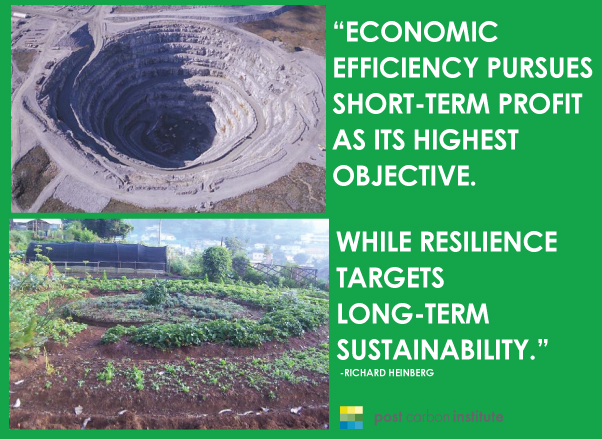
In many respects a resilient society defies the imperative of economic efficiency. Resilience needs dispersed inventories and redundancy, while economic efficiency—in its ruthless pursuit of competitive advantage—eliminates inventories and redundancies everywhere it can. Economic efficiency leads toward globalization, resilience toward localization. Economic efficiency pursues short-term profit as its highest objective, while resilience targets long-term sustainability. It would appear that industrial society circa 2012 has gone about as far in the direction of economic efficiency as it is possible to go, and that a correction is necessary and inevitable. Climate change simply underscores the need for that course correction.

Building resilience means helping society to work more like an ecosystem—and that has major implications for how we use energy. Ecosystems conserve energy by closing nutrient loops: plants capture and chemically store solar energy, which is then circulated as food throughout the food web. Nothing is wasted. We humans—having developed the ability to draw upon ancient, concentrated, cheap, and abundant (though ultimately finite) fossil fuels—have simultaneously adopted the habit of wasting energy on a colossal scale. Our food, transport, manufacturing, and dwelling systems burn through thirty billion barrels of oil and eight billion tons of coal per year; globally, humans use over four hundred quadrillion BTUs of energy in total. Even where energy is not technically going to waste, demand for it could be substantially reduced by redesigning our basic systems. More


Tuesday, August 21, 2012

Experts find mangroves can slow surge

(CNS): Evidence from the latest scientific research suggests that mangroves can reduce the height of wind and swell waves over relatively short distance. According to a report by the Nature Conservancy and Wetlands International wave height can be reduced by as much as 66% over 100 metres of mangroves.

With coastal populations particularly vulnerable to the impacts of extreme events such as storms and hurricanes researchers say mangrove forests can be used as a tool in coastal defence strategies making their conservation a key part of protection. Researchers say that more work needs to be done to better understand the role they can play in defending coasts.


While Cayman does provide for some protection of mangrove buffers under the planning regulations, the plant is still persistently removed in the face of development. This was evidence in 2010 when more than 370,000 sq.ft of costal mangrove was ripped up by the developer of the Ritz Carlton on land earmarked for the Dragon Bay development.

Michael Ryan was granted permission to rip out the mangrove more than two years ago but no development has taken place on the site. In addition the promised replenishment programme has also failed to materialize.

In this new report by the environmental researchers, the importance of dense healthy mangrove to protecting coastal areas from storms has been highlighted as the experts say the plant reduces the wave energy.

“While mangrove forests are usually found on shores with little incoming wave energy, they may receive larger waves during storms, hurricanes and periods of high winds. Large wind and swell waves can cause flooding and damage to coastal infrastructure. By reducing wave energy and height, mangroves can potentially reduce associated damage,” the authors of the new report state. More


Wednesday, August 8, 2012

Biochar Promises Bevy of Benefits for People and Planet

It’s hard to attend any kind of energy or sustainability conference these days without needing to pop a Xanax, but at the 2012 US Biochar Conference , held this week in Sonoma County, California, excitement trumped angst handily. That’s because biochar is a simple technology with the potential to ameliorate no fewer than five dire global crises –topsoil depletion, nitrogen runoff, solid waste disposal, drought and, drum roll please…climate change.

Biochar is essentially charcoal that is ground up and incorporated as a soil amendment. It’s made by slowly burning anything from walnut husks to dead tree limbs to poop – just put that feedstock into a simple biochar stove (or bury it underground), light up and presto, you’ve got gas and charcoal, two valuable products for farmers grappling with high energy prices and poor soil fertility.

Long the province of farmers and gardeners, biochar is now attracting the attention of the climate change community for its massive carbon sequestration potential. Of the ten finalists for the Virgin Earth Challenge’s $25 million prize for a proven carbon capture technology, three are biochar companies.

Climate activists are fans of technologies like renewable energy that are carbon neutral -- that is, they don’t add any more friggin’ CO2 to the atmosphere. But carbon neutrality alone won’t prevent us from reaching the dreaded tipping point climate scientist James Hansen warns of . According to Hansen, even if all fossil fuel emissions cease in 2015, we’ll still be above the safe limit of 350 ppm until the end of the century (we’re currently at 395 ppm, and CO2 has a long shelf life). That means, Hansen and a growing number of climate scientists and activists agree, we need to scale up carbon negative technologies that suck CO2 out of the atmosphere. Enter biochar which, alongside reforestation, grasslands restoration and regenerative agriculture techniques, can turn dust bowls into rich, lush carbon sinks. According to the Climate Trust , biochar has the potential to sequester 12% of the world’s current GHG emissions. More


Rising seas force flood of activity

A new analysis of worldwide temperatures over the past 60 years has found more evidence that global warming is already upon us, and is responsible for extreme heat waves.

Naturally, this refocuses attention on the current U.S. drought. Left out of the discussion is another, equally serious and already pressing consequence of human-induced climate change: sea-level rise.

With oceans expanding from the heat and with glaciers large and small melting away, sea levels have climbed more than 8 inches since 1880, and the current rate is about an inch and a quarter every decade.

One hot spot is the East Coast, where the land is sinking and nearby ocean currents are slowing, causing the water to rise faster. From Cape Hatteras, N.C., up through Cape Cod, Mass., in the past half century, the speed of increase in water level has been three to four times the global average. Yet the North Carolina legislature has essentially banned relevant state agencies from taking projections of accelerating sea-level rises into account in policy making.

Such shortsightedness is not only irrational, it’s foolish. By 2030, in many places on the U.S. coast, sea level rise due to global warming will have more than doubled the risk of floods 4 feet or more over high tide. Lands below this 4-foot mark are now home to 5 million Americans, as well as vital infrastructure.

Not all public officials have their heads in the dampening sand. Their actions fall into three broad categories: protection, accommodation and retreat.

Protective strategies include building or reinforcing structures such as levees, dikes and sea walls and also developing soft defenses such as marshes and beaches.

Accommodation means remodeling buildings and houses in areas prone to more flooding. More


Tuesday, August 7, 2012

Climate of Failure

The heady days of early 2009, when advocates for global action on climate change anticipated world leaders gathering later that year around a conference table in Copenhagen to reach a global agreement, are but a distant memory. Today, with many of these same leaders focusing their attention on jumpstarting economic growth, environmental issues have taken a back seat. For environmentalists, it may seem that climate policy has dropped from the political agenda altogether.

Environmentalists are just now waking up to the reality that if we're going to stop global warming, we're going to have to be a lot more politically savvy.

They're right. The world's biggest emitters have reached a consensus of sorts, but not the one hoped for in Copenhagen. In the United States, President Barack Obama has borrowed his energy policy -- "all of the above" -- from the Republicans. Europe has dithered on any further commitments to emissions reductions as governments have been completely consumed by the euro crisis. China and India have used the follow-on conferences to Copenhagen, held in Durban and Cancun, to decisively push international climate negotiations into the long weeds. Leaders' attention to climate policy is not coming back -- at least not in any form comparable to the plans being discussed just a few years ago.

Copenhagen will likely be remembered as the moment when advocates for action lost their innocence. For more than a decade, expectations had been raised for a grand global bargain to put a price on carbon that would compel a major reduction in greenhouse-gas emissions -- notably carbon dioxide -- over the coming decades. To understand why this bargain failed requires a basic understanding of where carbon dioxide comes from and how it is reduced. A very simple but powerful framework for such an understanding was proposed in the 1980s by Japanese scientist Yoichi Kaya. Kaya explained that future carbon dioxide emissions would be the product of four factors: population, economic activity, how we obtain our energy, and how we use that energy.

We can simplify these four factors even further. Population and income together are simply GDP, or aggregate economic activity, and the production and consumption of energy reflect the technologies of energy supply and demand. The resulting Kaya Identity -- as his equation has come to be called -- simply says:

Emissions = GDP x Technology

With this simple equation before us, we can see the fundamental challenge to reducing emissions: A rising GDP, all else equal, leads to more emissions. But if there is one ideological commitment that unites nations and people around the world in the early 21st century, it is that GDP growth is non-negotiable. Right now, leaders on six different continents are focused on efforts to grow GDP, and with it jobs and wealth. They're not as worried about emissions. More


Sunday, August 5, 2012

Reducing Dependence on Fossil Fuels Essential for Sustainable Progress in Small Island Developing States, Says UN Secretary-General

Small Island Developing States (SIDS) need to free themselves from dependence on fossil fuel imports and transform their energy sectors to encompass modern, efficient, clean and renewable sources of energy, Secretary-General Ban Ki-moon said in a message to an audience of prime ministers, ministers, international experts, civil society leaders and business executives at the Barbados Conference today.

Sustainable development is not possible without sustainable energy, the Secretary-General continued in his message to the conference Achieving Sustainable Energy for All in Small Island Developing States, convened by the Government of Barbados and the United Nations Development Programme (UNDP).

The worlds appetite for energy continues to grow, and the global thermostat continues to rise. My vision is a world with universal energy access; a doubling of the global rate of improvement in energy efficiency; and a doubling of renewable energy in our mix of fuel sources by 2030.

Small island developing states are highly dependent on imported oil and other fossil fuels for transport and electricity generation, which is a major source of economic volatility.

We know that although many Small Island Developing States are energy deficient in conventional energy, limitless potential for renewable energy and energy efficiency resides in our countries. The fundamental issue thus is how do we, as small island developing states with inherent structural problems and limited resources, convert this renewable energy potential into a tangible product that is accessible, affordable and adaptable, proclaimed Prime Minister, The Honourable Freundel Stuart in addressing delegates at the opening ceremony this morning.

In some small island states, switching to hydro, solar, geothermal or other renewable energy sources can free up to 30 percent of gross domestic product which is otherwise expended on imports of oil and refined petroleum products. The savings can be then invested into jobs in sectors such as clean energy, improved health care and education, stronger safety nets for people whose livelihoods will be affected by the phase out of fossil fuels, adaptation to climate change, and other programmes. More


Climate Change Is Here — And Worse Than We Thought

When I testified before the Senate in the hot summer of 1988 , I warned of the kind of future that climate change would bring to us and our planet. I painted a grim picture of the consequences of steadily increasing temperatures, driven by mankind’s use of fossil fuels.

But I have a confession to make: I was too optimistic.

My projections about increasing global temperature have been proved true. But I failed to fully explore how quickly that average rise would drive an increase in extreme weather.

In a new analysis of the past six decades of global temperatures, which will be published Monday, my colleagues and I have revealed a stunning increase in the frequency of extremely hot summers, with deeply troubling ramifications for not only our future but also for our present.

This is not a climate model or a prediction but actual observations of weather events and temperatures that have happened. Our analysis shows that it is no longer enough to say that global warming will increase the likelihood of extreme weather and to repeat the caveat that no individual weather event can be directly linked to climate change. To the contrary, our analysis shows that, for the extreme hot weather of the recent past, there is virtually no explanation other than climate change.

The deadly European heat wave of 2003, the fiery Russian heat wave of 2010 and catastrophic droughts in Texas and Oklahoma last year can each be attributed to climate change. And once the data are gathered in a few weeks’ time, it’s likely that the same will be true for the extremely hot summer the United States is suffering through right now.

These weather events are not simply an example of what climate change could bring. They are caused by climate change. The odds that natural variability created these extremes are minuscule, vanishingly small. To count on those odds would be like quitting your job and playing the lottery every morning to pay the bills.

Twenty-four years ago, I introduced the concept of “climate dice” to help distinguish the long-term trend of climate change from the natural variability of day-to-day weather. Some summers are hot, some cool. Some winters brutal, some mild. That’s natural variability.

But as the climate warms, natural variability is altered, too. In a normal climate without global warming, two sides of the die would represent cooler-than-normal weather, two sides would be normal weather, and two sides would be warmer-than-normal weather. Rolling the die again and again, or season after season, you would get an equal variation of weather over time.

But loading the die with a warming climate changes the odds. You end up with only one side cooler than normal, one side average, and four sides warmer than normal. Even with climate change, you will occasionally see cooler-than-normal summers or a typically cold winter. Don’t let that fool you.

Our new peer-reviewed study, published by the National Academy of Sciences, makes clear that while average global temperature has been steadily rising due to a warming climate (up about 1.5 degrees Fahrenheit in the past century), the extremes are actually becoming much more frequent and more intense worldwide. More


Tuesday, July 24, 2012

Searching for Clues to Calamity

SO far 2012 is on pace to be the hottest year on record. But does this mean that we’ve reached a threshold — a tipping point that signals a climate disaster?

For those warning of global warming, it would be tempting to say so. The problem is, no one knows if there is a point at which a climate system shifts abruptly. But some scientists are now bringing mathematical rigor to the tipping-point argument. Their findings give us fresh cause to worry that sudden changes are in our future.

One of them is Marten Scheffer, a biologist at Wageningen University in the Netherlands, who grew up swimming in clear lowland ponds. In the 1980s, many of these ponds turned turbid. The plants would die, algae would cover the surface, and only bottom-feeding fish remained. The cause — fertilizer runoff from nearby farms — was well known, but even after you stopped the runoff, replanted the lilies and restocked the trout, the ponds would stay dark and scummy.

Mr. Scheffer solved this problem with a key insight: the ponds behaved according to a branch of mathematics called “dynamical systems,” which deals with sudden changes. Once you reach a tipping point, it’s very difficult to return things to how they used to be. It’s easy to roll a boulder off a cliff, for instance, but much harder to roll it back. Once the ponds turned turbid, it wasn’t enough to just replant and restock. You had get them back to their original, clear state. More


Monday, July 23, 2012

Fool me twice, shame on me: The oil industry repackages the fake abundance story

[I]f you're still operating under the assumption that the earth's petroleum--or at least the cheap stuff--is about to run out, you're not going to thrive in the new oil era. Technology is making it possible to find, produce, and refine oil so efficiently that its supply, at least for practical purposes, is basically unlimited.

--BusinessWeek, December 14, 1998


That was the industry's story right before a decade-long climb in oil prices that ended with an all-time high in 2008. Only the oil industry would now have the audacity once again to peddle a story that it has gotten wrong for more than a decade as if it were brand new. Enlisting the media and its army of paid consultants, the industry is once again telling the public that oil abundance is at hand. And, what is doubly audacious is that it is promoting this tale as oil prices hover at levels more than eight times the 1999 low. Clearly, the industry is counting on collective amnesia to shield it from ridicule.

The industry's purpose is transparent: To ensure that the world remains addicted to fossil fuels by convincing all of us that our energy sources--more than 80 percent of which are fossil fuels--don't need to change. It's a winning strategy even if the industry's premise is wrong since the oil companies still have huge inventories of fossil fuels underground that they want to sell at top prices. And, they are only going to get those top prices if government, businesses and households fail to convert to alternatives and thus remain hostage to fossil fuels.

In a stroke of public relations genius, the industry recently sent one of its own, Leonardo Maugeri, an Italian oil executive, to moonlight as a "research fellow" at Harvard. It's hard to imagine a more prestigious name to use to propagate the industry's consistently overly optimistic pronouncements about oil supplies--even though we are told in italic type at the bottom of Maugeri's policy brief that "[s]tatements and views expressed in this policy brief are solely those of the author and do not imply endorsement by Harvard University, the Harvard Kennedy School, or the Belfer Center for Science and International Affairs." Guess how many media outlets printed that disclaimer.

You can find Maugeri's report here. What you won't find there or in current media accounts are his consistently failed predictions about rising supply in the last decade, supply that was supposed to result in a flood of oil. Here's one gem from 2006 in a piece he authored forForbes Magazine: "A plausible forecast is that by the end of the decade the daily demand for oil will have expanded by 7 to 8 million barrels. If global production continues at present rates, it could grow by 12 to 15 million barrels per day in that period. In other words, there is more than enough oil in the ground." Maugeri's contention was that high prices would result in a supply response that would bring back the good old days of abundance. Of course, no one covering his recent policy brief bothers to mention that his 2006 prediction turned out to be wrong, and not by just a little. World oil production has been flat since 2005. His vaunted supply response never materialized.More


Wednesday, July 18, 2012

New Waste-to-Energy Facility Helps Barbados Toward Greener Economy

BRIDGETOWN, Barbados, Jul 18 2012 (IPS) - When it comes to pursuing a greener path to economic development, the tiny Caribbean island of Barbados is not about to allow its small size and limited resources to get in its way.

Cell Four at Vaucluse, St.Thomas parish, Barbados. Credit: Desmond Brown/IPS
The island has opened the first phase of a multi-million-dollar state-of-the-art facility that will create energy from the tonnes of waste produced by households across the country.

Opening the facility, known as “Cell Four”, Prime Minister Freundel Stuart said Barbados has no choice but to diversify its energy resources to include more renewable and sustainable ones.

“Our fuel bill represents the heaviest demand on our foreign exchange. Fuel is of course, essential for the generation of electricity, the manufacture of goods, and for the transportation of goods and people.”

“These three development-oriented activities account for over 80 percent of our fuel consumption,” Stuart said.

With a population of 285,000, Barbados has a mammoth annual fossil fuel bill. According to Environment Minister Dr. Denis Lowe, it makes economic sense to convert waste to energy rather than simply burying it.

“We have a gluttonous appetite for energy,” he said. “It is in our best interest to ensure that we find alternative methods of generating energy to save our energy costs.”

The small island challenge

United Nations Secretary-General Ban Ki-Moon recently appealed to Barbados and other Small Island Developing States (SIDS) to free themselves from dependence on fossil fuel imports and transform their energy sectors to encompass modern, efficient, clean and renewable sources of energy.

Stuart said he agrees wholeheartedly with the Secretary-General, pointing out that last year, his country spent just under 4 million U.S. dollars on oil imports, or six percent of its gross domestic product. This spending has hurt direct production costs and the overall competitiveness of the Barbadian economy.

“Although many SIDS are energy deficient in conventional energy, limitless potential for renewable energy and energy efficiency resides in our countries,” Stuart said.

“The fundamental issue then is how, do we, as Small Island Developing States with inherent structural problems and limited resources, convert this renewable energy potential into a tangible product that is accessible, affordable and adaptable?”

Barbados has been actively promoting sustainable energy practices both on the supply side – mainly using renewable energy sources – and on the demand side, encouraging energy efficiency and energy conservation, in an effort to reduce its dependence on fossil fuels, enhance energy security and stability, improve the economy’s competitiveness and foster greater environmental sustainability.

Over 40,000 solar water heaters have installed on domestic and commercial buildings in Barbados, according to Stuart. At more than 45 percent, it is the fifth highest penetration of solar water heaters in the world. “We are using the country’s success in this industry as a platform for renewable energy development,” he added. More


Sunday, July 15, 2012

Toby Hemenway on sustainability and need

Hemenway is a frequent teacher, consultant and lecturer on permaculture and ecological design throughout the U.S. and other countries. His writing has appeared in magazines such as Natural Home, Whole Earth Review and American Gardener. He is an adjunct professor in the School of Graduate Education at Portland State University, a Scholar-in-Residence at Pacific University, and a biologist consultant for the Biomimicry Guild.

Antarctica at Risk from Human Activities

The continent of Antarctica is at risk from human activities and other forces, and environmental management is needed to protect the planet's last great wilderness area, says an international team of researchers, including a Texas A&M University oceanographer, in a paper published in the current issue of Science magazine.


Mahlon "Chuck" Kennicutt II, professor of oceanography who has conducted research in the area for more than 25 years, says Antarctica faces growing threats from global warming, loss of sea ice and landed ice, increased tourism, over-fishing in the region, pollution and invasive species creeping into the area. One of the longer-term concerns that may present the greatest threat overall is the potential for oil, gas and mineral exploitation on the continent and in the surrounding ocean, the authors note.

Kennicutt says the Antarctic Treaty System that governs the continent has worked well since it was established in 1962 and that 50 countries currently adhere to the treaty, but it is under pressure today from global climate changes and the ever-present interest in the area's natural resources, from fish to krill to oil to gas to minerals.

"Many people may not realize that Antarctica is a like a 'canary in a coal mine' when it comes to global warming, and Antarctica serves as a sort of thermostat for Earth," he points out. "The polar regions are the most sensitive regions on Earth to global warming, responding rapidly, so what happens in Antarctica in response to this warming affects the entire Earth system in many ways that we barely understand," Kennicutt explains. "Antarctica contains over 90 percent of the fresh water in the world, locked up as solid water in its massive ice sheets. Research that develops fundamental knowledge and understanding of these complex systems conducted in and from Antarctica is critical to understanding many of the challenges facing Earth today."

In addition to conducting research in the area, Kennicutt is also president of the Scientific Committee for Antarctic Research (SCAR), formed in 1958 to coordinate international research in the region. More


Thursday, July 12, 2012

Throwaway Economy Headed for Junk Heap of History

In their book Cradle to Cradle: Remaking the Way We Make Things, American architect William McDonough and German chemist Michael Braungart conclude that waste and pollution are to be avoided entirely. “Pollution,” says McDonough, “is a symbol of design failure.”

The challenge is to re-evaluate the materials we consume and the way we manufacture products so as to cut down on waste. Restructuring the transportation system has a huge potential for reducing materials use as light rail and buses replace cars. For example, 60 cars, weighing a total of 110 tons, can be replaced by one 12-ton bus, reducing material use 89 percent.

Savings from replacing a car with a bike are even more impressive. Urban planner Richard Register recounts meeting a bicycle-activist friend wearing a T-shirt that said, “I just lost 3,500 pounds. Ask me how.” When queried, he said he had sold his car. Replacing a 3,500-pound car with a 22-pound bicycle obviously reduces fuel use dramatically, but it also reduces materials use by 99 percent, indirectly saving still more energy.

Cutting the use of virgin raw materials begins with recycling steel, the use of which dwarfs that of all other metals combined. In the United States, virtually all cars are recycled. They are simply too valuable to be left to rust in out-of-the-way junkyards. With the number of cars scrapped now exceeding new cars sold, the U.S. automobile sector actually has a steel surplus that can be used elsewhere in the economy.

The U.S. recycling rate for household appliances is estimated at 90 percent. For steel cans it is 65 percent. For construction steel, the figures are 98 percent for steel beams and girders but only 65 percent for reinforcement steel.

Beyond reducing materials use, the energy savings from recycling are huge. Making steel from recycled scrap takes only 26 percent as much energy as that from iron ore. For aluminum, the figure is just 4 percent. Recycled plastic uses only 20 percent as much energy. Recycled paper uses 64 percent as much—and with far fewer chemicals during processing. If the world recycling rates of these basic materials were raised to those already attained in the most efficient economies, world carbon emissions would drop precipitously.

The rates of paper recycling in the top 10 paper-producing countries range widely—from China and Finland on the low end, recycling less than 40 percent of the paper they use, to Japan and Germany on the higher end, each between 70 and 80 percent, and South Korea, which recycles an impressive 91 percent. The United States, the world’s largest paper consumer, is far behind the leaders, but it has raised the share of paper recycled from roughly 20 percent in 1980 to 59 percent in 2009. If every country recycled as much of its paper as South Korea does, the amount of wood pulp used to produce paper worldwide would drop by more than one third.

In the United States, only 33 percent of garbage is recycled. Some 13 percent is burned and 54 percent goes to landfills, indicating a huge potential for reducing materials use, energy use, and pollution. Among the larger U.S. cities, recycling rates vary from 25 percent in New York to 45 percent in Chicago, 65 percent in Los Angeles, and 77 percent in San Francisco, the highest of all.

One way to encourage recycling is simply to adopt a landfill tax. For example, when the small town of Lyme, New Hampshire, adopted a pay-as-you-throw (PAYT) program that encourages municipalities to charge residents for each bag of garbage, it dramatically reduced the flow of materials to landfills, raising the share of garbage recycled from 13 to 52 percent in only one year, simultaneously reducing the town’s landfill fees, and generating a cash flow from the sale of recycled material. Nationwide, more than 7,000 U.S. communities now have PAYT programs. More


IPCC announces call for applications for second round of awards under the IPCC Scholarship Programme

IPCC announces call for applications for second round of awards under the IPCC Scholarship Programme

The Intergovernmental Panel on Climate Chance (IPCC) has opened a call for applications for the second round of awards under the IPCC Scholarship Programme.

The IPCC Scholarship Programme aims to build capacity in the understanding and management of climate change in developing countries by providing opportunities for young scientists from developing countries to undertake studies that would not be possible without funding under the programme.

Applicants must be post-graduate students under the age of 30 studying at PhD level. They must have already been accepted at a recognized educational institution to start studies in 2013, or be currently enrolled on continuing PhD courses. Research proposals should focus on one of the following fields of study:

* Socio-economic modelling related to climate change

* Underlying science of climate change

* Climate change and water

Applicants must be nationals of developing countries and priority will be given to students from Least Developed Countries (LDCs) and Small Island Developing States (SIDS).

With a value of up to USD 20,000 per year, each award will be given for a period of one year and is renewable once, subject to satisfactory progress during the period of study and term reports signed by the research supervisor.

Applications will undergo a two-level selection process. IPCC scientific experts will first assess the applications in an initial review and the IPCC Science Board will then review the applications and make a final selection. The candidates selected for an award will be notified individually during the second quarter of 2013.

The IPCC Scholarship Programme was established with the funds received from the 2007 Nobel Peace Prize. The IPCC Scholarship Programme benefits from the support of the Prince Albert II of Monaco Foundation.

Students interested in applying for an IPCC scholarship can download application forms at:

http://www.ipcc.ch/ipcc-scholarship-programme/ipcc_scholarshipprogramme.shtml

Completed application forms and supporting documents should be uploaded by 30 September 2012 at:

https://www.ipcc.ch/apps/scholarship/applicant/


Sunday, July 8, 2012

Hurricane Protection and Carbon Sink

Under the Kyoto agreement, existing forestry does not qualify to be traded for carbon credits. However, newly created plantations do.

Monday, July 2, 2012

Effects of Climate Change Hit Home

More than 400,000 people are still without power in the Washington, D.C. area after one of the region’s most bizarre and damaging storms in history.

I am one of them.

The lights and air conditioning went out at my place around 10 p.m. three days ago, just as a half-dozen little girls were settling down in sleeping bags as part of my 7-year-old daughter’s sleepover birthday party. Cleanup from the storms that toppled 50-foot oak trees and ripped down power lines throughout my neighborhood will keep us without electricity perhaps for a week, we’re told, while the region continues to swelter in near 100-degree heat – about 10 degrees higher than average for this time of year and hovering around historical records.

Those of us in Washington, however, are lucky compared to the people of Colorado, where at least 350 families have lost their homes so far to the state’s worst wildfires on record. About 100,000 acres of some of our nation’s prettiest forests have already gone up in smoke, and the state is still on fire. The effects of climate change, once viewed as some far-off abstraction that could be denied or debated, are beginning to be felt here and now.

According to meteorologists, it is a historic record-setting heat wave in Washington that caused the powerful storm known as a “derecho” that left at least 18 people dead and our nation’s capital battered, bruised and sweltering in the dark.

Out in Colorado, climate change has led to drought, abnormally low snowfall and warmer winters. These events are far reaching: Warmer winters, for example, have resulted in an explosion in white pine bark beetles that kill trees and turn them in to ready-to-burn tinder.

There’s not always a direct link between weather disasters, a warming planet and the heat-trapping carbon emissions that have been rising since the advent of the Industrial Age and our dependence on burning fossil fuels.

But increasingly, there is a connection between climate change and extreme weather. Those who want to deny it – or irresponsibly try to convince the public that they too should deny it – should do some research and some reading before they turn their heads the other way. More


Sunday, July 1, 2012

Sea Level Rise Accelerating in U.S. Atlantic Coast

Rates of sea level rise are increasing three-to-four times faster along portions of the U.S. Atlantic Coast than globally, according to a new U.S. Geological Survey report published in Nature Climate Change.

Since about 1990, sea-level rise in the 600-mile stretch of coastal zone from Cape Hatteras, N.C. to north of Boston, Mass. -- coined a "hotspot" by scientists -- has increased 2 - 3.7 millimeters per year; the global increase over the same period was 0.6 – 1.0 millimeter per year.

Based on data and analyses included in the report, if global temperatures continue to rise, rates of sea level rise in this area are expected to continue increasing.

The report shows that the sea-level rise hotspot is consistent with the slowing of Atlantic Ocean circulation. Models show this change in circulation may be tied to changes in water temperature, salinity and density in the subpolar north Atlantic.

"Many people mistakenly think that the rate of sea level rise is the same everywhere as glaciers and ice caps melt, increasing the volume of ocean water, but other effects can be as large or larger than the so-called 'eustatic' rise," said USGS Director Marcia McNutt. "As demonstrated in this study, regional oceanographic contributions must be taken into account in planning for what happens to coastal property."

Though global sea level has been projected to rise roughly two-to-three feet or more by the end of the 21st century, it will not climb at the same rate at every location. Differences in land movements, strength of ocean currents, water temperatures, and salinity can cause regional and local highs and lows in sea level.

"Cities in the hotspot, like Norfolk, New York, and Boston already experience damaging floods during relatively low intensity storms," said Dr. Asbury (Abby) Sallenger, USGS oceanographer and project lead. "Ongoing accelerated sea level rise in the hotspot will make coastal cities and surrounding areas increasingly vulnerable to flooding by adding to the height that storm surge and breaking waves reach on the coast."

During the 21st century, the increases in sea level rise rate that have already occurred in the hotspot will yield increases in sea level of 8 to 11.4 inches by 2100. This regional sea level increase would be in addition to components of global sea level rise. More


Friday, June 29, 2012

Arctic sea-ice levels at record low for June

Scientists say that the latest observations suggest that Arctic sea ice cover is continuing to shrink and thin.


Sea ice in the Arctic has melted faster this year than ever recorded before, according to the US government's National Snow and Ice Data Centre (NSIDC).

Satellite observations show the extent of the floating ice that melts and refreezes every year was 318,000 square miles less last week than the same day period in 2007, the year of record low extent, and the lowest observed at this time of year since records began in 1979. Separate observations by University of Washington researchers suggest that the volume of Arctic sea ice is also the smallest ever calculated for this time of year.

Scientists cautioned that it is still early in the "melt season", but said that the latest observations suggest that the Arctic sea ice cover is continuing to shrink and thin and the pattern of record annual melts seen since 2000 is now well established. Last year saw the second greatest sea ice melt on record, 36% below the average minimum from 1979-2000.

"Recent ice loss rates have been 100,000 to 150,000 square kilometres (38,600 to 57,900 square miles) per day, which is more than double the climatological rate. While the extent is at a record low for the date, it is still early in the melt season. Changing weather patterns throughout the summer will affect the exact trajectory of the sea ice extent through the rest of the melt season," said a spokesman for the NSIDC.

The increased melting is believed to be a result of climate change. Arctic temperatures have risen more than twice as fast as the global average over the past half century. More


Monday, June 25, 2012

Significant Sea-Level Rise in a Two-Degree Warmer World

ScienceDaily (June 24, 2012) — Sea levels around the world can be expected to rise by several metres in coming centuries, if global warming carries on. Even if global warming is limited to 2 degrees Celsius, global-mean sea level could continue to rise, reaching between 1.5 and 4 metres above present-day levels by the year 2300, with the best estimate being at 2.7 metres, according to a study just published in Nature Climate Change. However, emissions reductions that allow warming to drop below 1.5 degrees Celsius could limit the rise strongly.

The study is the first to give a comprehensive projection for this long perspective, based on observed sea-level rise over the past millennium, as well as on scenarios for future greenhouse-gas emissions.

"Sea-level rise is a hard to quantify, yet critical risk of climate change," says Michiel Schaeffer of Climate Analytics and Wageningen University, lead author of the study. "Due to the long time it takes for the world's ice and water masses to react to global warming, our emissions today determine sea levels for centuries to come."

Limiting global warming could considerably reduce sea-level rise

While the findings suggest that even at relatively low levels of global warming the world will have to face significant sea-level rise, the study also demonstrates the benefits of reducing greenhouse-gas emissions. Limiting global warming to below 1.5 degrees Celsius and subsequent temperature reductions could halve sea-level rise by 2300, compared to a 2-degree scenario. If temperatures are allowed to rise by 3 degrees, the expected sea-level rise could range between 2 and 5 metres, with the best estimate being at 3.5 metres.

The potential impacts are significant. "As an example, for New York City it has been shown that one metre of sea level rise could raise the frequency of severe flooding from once per century to once every three years," says Stefan Rahmstorf of the Potsdam Institute for Climate Impact Research, co-author of the study. Also, low lying deltaic countries like Bangladesh and many small island states are likely to be severely affected.

Sea-level rise rate defines the time for adaptation

The scientists further assessed the rate of sea-level rise. The warmer the climate gets, the faster the sea level climbs. "Coastal communities have less time to adapt if sea-levels rise faster," Rahmstorf says.

"In our projections, a constant level of 2-degree warming will sustain rates of sea-level rise twice as high as observed today, until well after 2300," adds Schaeffer, "but much deeper emission reductions seem able to achieve a strong slow-down, or even a stabilization of sea level over that time frame." More