Sunday, February 16, 2014

The Asia Pacific Clean Energy Summit & Expo - Call for Papers'

The Asia Pacific Clean Energy Summit & Expo

Co-located with the Islands Innovation Summit & Showcase/ Pacific Defense Energy Summit & Showcase

September 15-17, 2014

Honolulu Convention Center, Honolulu, HI

http://islandsconnect.com

The event is the preeminent meeting place for international leaders and energy experts at the forefront of the clean energy movement. Securing energy independence and developing a clean energy industry that promotes the vitality of our planet are two reasons why it is critical to reaffirm already established partnerships and build new ones throughout the Asia-Pacific region and the world. The summit will provide a forum for the high-level global networking necessary to advance this emerging clean energy culture.

'Call for Papers' Submission deadlines:

Panel Proposals - Due March 28th

Islands Innovation Challenge & Defense Energy Challenge - Due May 31st

For further information, partnerships, island/community showcase, or group programs, please contact Regina Ramazzini at regina@techconnect.org

Friday, February 14, 2014

Expecting the Unexpected: Abrupt Climate Change

Senior scientists discuss the potential for abrupt disruptions of human and natural systems as a consequence of climate change.


Thursday, February 13, 2014

Pacific island states ‘must think beyond grid to electrify’

JAKARTA, Indonesia ---- Despite advances in research and development on renewable energy, Small Island Developing States (SIDS) in the Pacific remain the most energy-poor in the world, with an estimated 70 per cent of the population still without access to reliable energy.

A paper from the Crawford School of Public Policy at the Australian National University lays the blame on the pervasive focus on traditional approaches to rural electrification that prioritise grid extension. Grid extensions connect a home to a local utility grid.

But extending the grid lines in the Pacific region whose populations are spread across tens of thousands of islands may not be suitable and cost effective, the paper says.

“Both utility agencies and the private sector need incentives to extend electricity grids and to set up off-grid systems in rural areas. To provide those incentives, government subsidisation of upfront costs is necessary instead of merely subsidising operation and maintenance costs,” says Matthew Dornan, the primary author of the report.

Dornan says off-grid electrification projects, which involve mainly renewable energy, may be more sustainable in the long term. However, it requires significant upfront costs that are often impossible for local households or government to shoulder, he says.

“In terms of off-grid technologies, the key is simplicity,” explains Dornan. “Technologies should only be installed where they can be supported by institutional arrangements, be that a utility agency or a community technician.”

Renewables may play a stronger role in low-density, off-grid networks, but only with large-scale support, experts say.

According to Linus Mofor, a spokesperson for the International Renewable Energy Agency, “institutional strengthening, increased collaboration among islands and enhanced coordination of development partners, donors, regional institutions and national authorities and institutions are essential for efficient use of resources for renewables deployment in the region.”

Though his paper focused on SIDS, Dornan believes that his findings can help governments and development institutions alike in tackling the challenges of energy poverty.

“Sub-Saharan African and Pacific island countries can learn from one another given the capacity constraints that governments in both regions share,” he notes. More


Casino Capitalism - Or Why America Has Forgotten Its Three Biggest Economic Lessons

Why has America forgotten the three most important economic lessons we learned in the thirty years following World War II?

Before I answer that question, let me remind you what those lessons were:

First, America’s real job creators are consumers, whose rising wages generate jobs and growth. If average people don’t have decent wages there can be no real recovery and no sustained growth.

In those years, business boomed because American workers were getting raises, and had enough purchasing power to buy what expanding businesses had to offer. Strong labor unions ensured American workers got a fair share of the economy’s gains. It was a virtuous cycle.

Second, the rich do better with a smaller share of a rapidly-growing economy than they do with a large share of an economy that’s barely growing at all.

Between 1946 and 1974, the economy grew faster than it’s grown since, on average, because the nation was creating the largest middle class in history. The overall size of the economy doubled, as did the earnings of almost everyone. CEOs rarely took home more than forty times the average worker’s wage, yet were riding high.

Third, higher taxes on the wealthy to finance public investments — better roads, bridges, public transportation, basic research, world-class K-12 education, and affordable higher education – improve the future productivity of America. All of us gain from these investments, including the wealthy.

In those years, the top marginal tax rate on America’s highest earners never fell below 70 percent. Under Republican President Dwight Eisenhower the tax rate was 91 percent. Combined with tax revenues from a growing middle class, these were enough to build the Interstate Highway system, dramatically expand public higher education, and make American public education the envy of the world.

We learned, in other words, that broadly-shared prosperity isn’t just compatible with a healthy economy that benefits everyone — it’s essential to it.

But then we forgot these lessons. For the last three decades the American economy has continued to grow but most peoples’ earnings have gone nowhere. Since the start of the recovery in 2009, 95 percent of the gains have gone to the top 1 percent.

What happened?

For starters, too many of us bought the snake oil of “supply-side” economics, which said big corporations and the wealthy are the job creators – and if we cut their taxes the benefits will trickle down to everyone else. Of course, nothing trickled down.

Meanwhile, big corporations were allowed to bust labor unions, whose membership dropped from over a third of all private-sector workers in the 1950s to under 7 percent today.

Our roads, bridges, and public-transit systems were allowed to crumble under the weight of deferred maintenance. Our public schools deteriorated. And public higher education became so starved for funds that tuition rose to make up for shortfalls, making college unaffordable to many working families.

And Wall Street was deregulated — creating a casino capitalism that caused a near meltdown of the economy six years ago and continues to burden millions of homeowners. CEOs began taking home 300 times the earnings of the average worker.

Part of the reason for this extraordinary U-turn had to do with politics. As income and wealth concentrated at the top, so did political power. The captains of industry and of Wall Street knew what was happening, and some played leading roles in this transformation.

But why didn’t they remember the lessons learned in the thirty years after World War II – that widely-shared prosperity is good for everyone, including them?

Perhaps because they didn’t care to remember. They discovered that wealth is also relative: How rich they feel depends not just on how much money they have, but also how they live in comparison to most other people.

As the gap between America’s wealthy and the middle has widened, those at the top have felt even richer by comparison. Although a rising tide would lift all boats, many of America’s richest prefer a lower tide

Robert B. Reich has served in three national administrations, most recently as secretary of labor under President Bill Clinton. He also served on President Obama's transition advisory board. His latest book is "Aftershock: The Next Economy and America's Future." More

His homepage is www.robertreich.org.


Wednesday, February 12, 2014

Utilities: Survival course for dinosaurs (advice from one of our own

Steve Klein recently served as a utility industry panelist at a conference where he introduced himself as a living, breathing dinosaur. It was not his intent to imply that he was really old, or not hip to the latest trends. Rather, he was making the point that this description was now being applied to electric power utility executives..

Citibank published a report titled “Energy Darwinism” that led industry analyst Jesse Berst to coin the prophetic phrase “Utilities are Dinosaurs Waiting to Die.” The original report argues that the utility industry’s dismissive attitude toward disruptive technological changes mirrors that of those who failed to recognize the game-changing impact of the Internet and cell phones. The report suggests that today’s electric power utilities could lose a substantial portion of their market to energy efficiency, solar, and other distributed generation technologies. Citibank further emphasized that history tells us such changes are never gradual.

Earlier this year, Marlene Motyka, an alternative energy advisor for Deloitte LLP, wrote an op-ed titled, “Why We Should Pity Utilities.” She highlighted the fact that utility “companies are caught in a vise: squeezed by simultaneously rising expenses combined with falling demand for electricity.”

Motyka was only addressing a portion of the vise. To complete the entire squeeze play, you also have to factor in legislative and regulatory pressure on utilities to fund large expansions of the nation’s transmission grid, as well as renewable portfolio standards, to ultimately promote large-scale commercial wind and solar development that likely will only add to the oversupply problem.

As I write this I am reminded of a clean tech venture capitalist who served with me on a panel that was charged with helping the previous governor of Washington establish a state energy strategy. Every time I made what I thought was an insightful comment from the utility perspective, he would whisper sarcastically to me, “Spoken like a true power company executive.” The electric utility industry is being accused today of resisting consumer demands by protecting its traditional business model in much the same way that Ma Bell sought to maintain control of its big black rotary telephone. Are we simply protectionists or dinosaurs that don’t want to adapt and accommodate technological advancement? Are we irrationally trying to preserve our version of the rotary phone?

I don’t want to be perceived like Ma Bell, but I do believe there are foundational elements of our industry that were put in place years ago and have served the nation and its citizens well. Unlike other parts of the world, everyone in America has access to safe, reliable, and affordable electricity at the flick of a switch. On the other hand, I would argue that we must adapt to the changing needs of our customers even if that means facilitating the application of new technologies that threaten our traditional business model.

I believe the best strategy going forward also happens to reflect my view of where we are heading as an industry. First of all, conservation and renewables are a legacy of the Pacific Northwest and should continue to be the first and foremost tools in our tool belt. As public utilities, we need to lead the way in making sure our communities are economically and ecologically sustainable through wise and efficient use of resources. Consumer-owned utilities do not exist merely to sell kilowatts and return generous cash dividends to detached shareholders; our dividends are evident through our unique values of local control, economic development, environmental and community stewardship, and overall quality of life. Public power utilities will have to become more creative to continue to be able to sustain strong conservation programs despite flat or declining energy load.

Utilities should also embrace the fact that a growing number of their customers want to avail themselves of distributed resources such as solar. We should develop community- based programs to educate and assist those who want to participate directly in supporting local renewable generating sources. Such programs can provide education and appropriate incentives as well as promote local economic development, similar to the many successful public power conservation efforts.

Rather than simply saying “no” to those in your community who look to the local utility for guidance, you should find ways to say “yes.” You can structure your program and rate design to address the potential revenue and nonparticipant impacts. I don’t expect distributed generation to grow as fast and have as large an impact in the Northwest as other parts of the country because of our comparatively low retail rates and underlying renewable resource base made up of non-carbon-emitting hydro. Resistance is not the best approach; it is better to work with customers, legislators, and regulators to meet this growing consumer interest. Our proactive stance will position us to better influence the solutions to adequately address reliability, safety, and economic impacts.

I see our role as power utilities changing over the ensuing years, but I also see certain fundamental aspects remaining unchanged in terms of utilities remaining mass market service providers. The grid system will become more and more complex, developing a multitude of interfaces with variable distributed generation as well as innovative service offerings and pricing schemes ranging from demand response to energy storage. This represents a challenging area upon which all electric utilities should be strategically focused. More buildings will become smart; they will have their own generating sources and energy management systems, and will be able to communicate on a real-time basis. The local distribution utility will still provide some level of central station generation, but it will be supplemented by local distributed generation as well as strategically sited utility- and customer-owned energy storage.

I think lots of people are interested in environmental sustainability and are willing to have a passively managed solar panel on their roof, but most consumers are not interested in becoming experts and committing the time necessary to effectively manage inverters, batteries, communications protocols, etc. That’s where the local utility comes in. We can provide a smart grid system that has the ability to balance and optimize all of the inputs and outputs to ensure that each customer has the energy they need when they need it.

We can no longer be satisfied with our form of Ma Bell’s black rotary dial phone, which is represented by an unsophisticated, one-way electric system highway. We cannot ignore the interests of our customers, who are demanding technological change and the provisioning of new services. With change comes opportunity, and I believe public power is well positioned to lead the way to the future utility service model, rather than going extinct like the brontosaurus and the black rotary telephone.

Steve Klein is the general manager of Snohomish County PUD in Everett, Wash. He can be contacted at sjklein@snopud.com. More


Tuesday, February 11, 2014

Wind of change sweeps through energy policy in the Caribbean

Aruba in the southern Caribbean has 107,000 people, a lot of wind and sun and, until very recently, one very big problem. Despite the trade winds and sunshine, it was spending more than 16% of its economy on importing 6,500 barrels of diesel fuel a day to generate electricity. People were furious at the tripling of energyprices in 10 years and the resulting spiralling costs of imported water and food.

A juice cafe in Tortola BVI

That changed at the Rio earth summit in 2012, when the prime minister, Mike Eman, announced that the former oil-producing Dutch island close to Venezuela planned to switch to 100% renewables by 2020.

Working with the independent US energy group the Rocky Mountain Institute and the business NGO Carbon War Room, Aruba ditched its old steam turbines for more efficient engines and changed the way it desalinated seawater.

Amory Lovins, chief scientist at the Rocky Mountain Institute.

It cost $300m (£183m), says the energy minister and deputy PM Mike D'Emeza, but Aruba immediately halved its fuel consumption and saved itself $85m a year. It then built a 30MW wind farm and cut its diesel consumption a further 50%. Now it is planning another wind farm and a large solar park. By 2020, Aruba will be free from fossil fuels and possibly storing renewable electricity under water or using ice.

The move to energy independence has had dramatic results, says De Meza. Electricity prices, which were US 33c/ KwH in 2009, have dropped 25% and are stable; inflation has been reversed; the island has nearly paid off the $300m it cost to switch out of diesel; the price of drinking water has fallen by almost a third; and the number of people unable to pay their bills has declined drastically.

"We had been grappling with very high energy costs for 15 years. We realised that our dependency on fossil fuels was leading to political and economic instability. We had to act," De Meza says.

Aruba is already enjoying health and economic benefits. More tourists are keen to visit a green island, he adds, and children are fitter because it costs families less to pay for sports, and there is less illness. "It has been very popular. Instead of energy prices being the top of the political agenda, the debate now is about which is the best renewable energy source Aruba should go for next."

Many other Caribbean islands are eager to follow Aruba. Some in the region pay more than 42c/ kwh – three or four times the price paid in most of the US and Europe – and up to 25% of their GDP on diesel for electricity.

Many are also locked into long-term contracts with monopolistic US or Canadian utility companies which have negotiated 17% or even higher guaranteed profit margins.

With many states also having to pay off onerous long-term loans to regional banks, the net effect of high power costs is continual misery, says Nicholas Robson, director of the Cayman Institute think tank. "People are coming to me saying they cannot afford electricity. It costs 42c [US$] in the Caymans. It's approaching a crisis point. People are struggling because of energy prices."

"We are very concerned about the high cost of energy and how it affects jobs," BVI prime minister Orlando Smith adds.

"We pay 38c/ KwH," says James Fletcher, St Lucia's energy and science minister. "The result is that industries like tourism, which are very heavy electricity users, are not competitive, our agriculture cannot move out of being just primary commodity producers, and our people have no money."

St Lucia plans over the next 10 years to switch much of its electricity from diesel to renewables, using geothermal, wind and solar power. The government will make it easier for people to generate their own electricity to reduce diesel demand, and changing street lights to LEDs could reduce costs by $11m a year, he explains.

"Renewables will provide new jobs, everyone will have more money in their pockets, transport will be cheaper and companies will be able to expand more easily," Fletcher says.

"Islands can get prices down to just 12c/ KwH," says Ed Bosage, a wealthy American financier who bought the small island of Over Yonder Cay and who has switched it to 96% renewables with wind, solar and a tidal generator. "The wind blows at an average of 16 knots. The tidal is extremely reliable. We learned that wind trumps sun by 2:1. We now produce electricity for 12c, the cheapest in the Caribbean, and will get it cheaper. It's repeatable everywhere," he says.

Caribbean islands share similar problems to thousands of others in the Pacific and elsewhere. Mostly, they are not on national grids, which makes them vulnerable to high energy costs, fuel has to be imported at extra cost, and they are often reliant on just one utility company and most are too small to benefit from economies of scale.

While some can attract high-spending tourists and offshore finance companies, small island states are often heavily indebted, with weak economies, pockets of intense poverty and often rundown hospitals and schools.

But, says Peter Lilienthal, director of Colorado-based Homer Energy and former US national energy laboratory chief, islands stand to benefit from the renewable revolution more than anyone. "Diesel is now hurting small islands. They are burning money. But the price of solar has plummeted in the last few years. It's now cost-efficient everywhere. Islands now can be the leaders."

Jamaica is investing heavily in wind, Barbados in solar power and eight island states – Aruba, British Virgin Islands, Dominica, St Kitts and Nevis, Grenada, St Lucia, Turks and Caicos,and the Colombian islands of Providencia and San Andreas have joined the Carbon War Room's "10 island challenge". This gives them access to technological and funding help from the Rocky Mountain Institute and others.

"Renewables have come slowly to the Caribbean and other developing countries but the technology is now cheap enough and diverse enough to make it much easier to install," says Amory Lovins, chief scientist at the Rocky Mountain Institute. "Small islands can move fast if they have coherent policies. They can be the future." More


Tuesday, February 4, 2014

Cayman's Delegation at Creating Climate Wealth Summit

Hon Marco Archer and Hon Wayne Panton

The Hon Marco Archer, MLA, Minister of Finance & Economic Development and the Hon. Wayne Panton, MLA, Minister of Financial Services, Commerce and Environment at the Carbon War Room's Creating Climate Wealth Summit on Moskito Island, BVI.

The Carbon War Room's Mission states 'Islands face increasing challenges from their dependence on imported fossil fuels, which impacts the prices they pay for everything from electricity to food. This is further complicated by the added demand that tourism places on the island’s resources. Natural energy resources are abundant on islands. However, the systems required to use them have not been widely implemented and scaled.


This lack of implementation is the result of multi-market barriers that islands and technology providers encounter. These multi-market barriers include local permitting, long-term fossil fuel contracts, and other legislative barriers. What is missing is a scaled regional approach to these barriers.
Sir Richard Branson addressing the plenary session

We seek to bridge this gap by working with islands to identify these barriers and create a regional roadmap for making the necessary changes. This roadmap would detail solutions that can attract both private sector investment and aggregated demand for large-scale renewable energy systems. Learn more about our island selection criteria in the background section.

Our finish line has islands rich with renewable energy systems–and with a strong commitment to fast track becoming completely fossil-fuel-free'.


Tuesday, January 28, 2014

Southern Hemisphere Climate Changes

Paul Beckwith explains how declining Arctic sea ice is causing Australia to bake and Antarctic sea ice to grow. Animations used are Southern Hemisphere temperature anomalies, temperatures, jet steams, sea surface temperature and precipitation.

Renewable Energy To Boost Jobs

21 January 2014: The Renewable Energy Jobs Conference, organized by the International Renewable Energy Agency (IRENA), took place in connection with the World Future Energy Summit. The Conference discussed how the renewables sector has become a significant employer with potential for creating millions more jobs worldwide in coming years.

At the Conference, IRENA launched a report on job creation in the renewable energy sector, which indicates that wind power employment more than doubled over the past five years, and solar photovoltaic employment grew nearly 13 fold over the same period. In the report, titled 'Renewable Energy and Jobs,' IRENA explains it expects these growth trends to continue, and estimates that the 5.7 million people employed directly or indirectly by renewables in 2012 could nearly triple to 16.7 million by 2030. The report finds that while the bulk of renewables employment is concentrated in Brazil, China, the EU, India and the US, many other countries are also gaining ground. It notes that, with recent manufacturing price reductions, the employment landscape has also changed in recent years, with increases in installation, maintenance and repair employment opportunities rapidly outstripping jobs in the manufacturing sector.


Aside from its statistical analyses of the global jobs market for renewables, the report contains chapters on: renewable energy employment figures and trends; measuring employment from renewable energy; policy instruments in support of job creation in the renewable energy sector; renewable energy skills, occupations, education and training; job creation in the context of energy access; gender dimensions of renewable energy employment; and policy recommendations.


The conference on jobs, which took place on 21 January 2014, in Abu Dhabi, United Arab Emirates (UAE), provided an opportunity for experts and policy makers to share knowledge, experiences and best practices on renewable energy job creation. In closing the Conference, Hugo Lucas, Director of IRENA's Knowledge, Policy and Finance Centre, stressed the importance of more awareness, social support and active people to drive the renewable energy transition. More


Utilities Feeling Rooftop Solar Heat Start Fighting Back

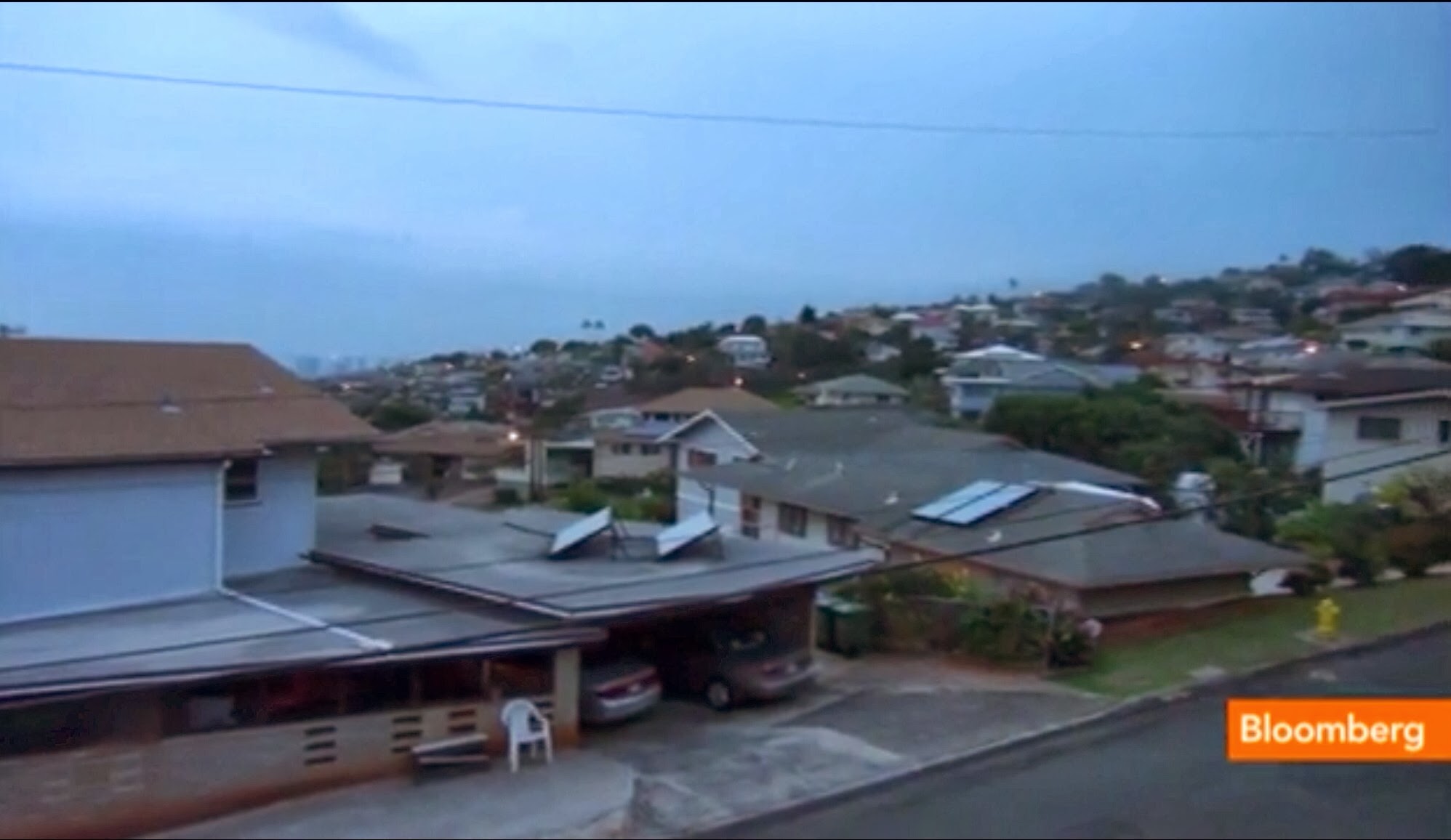
If you wonder why America’s utilities are rattled by the explosive growth in rooftop solar -- and are pushing back -- William Walker has a story for you.

Ewa Beach Oahu.

A flip-flop wearing Walker stands in his driveway pointing to a ubiquitous neighborhood feature – solar panels on the roofs of five of six houses nearby. He lives in Ewa Beach, a development on the sultry leeward coast of the Hawaiian island of Oahu built on land cleared of sugar cane fields.

Shade is scarce and residents here call their homes “hot boxes,” requiring almost round-the-clock air conditioning. Hawaii, which imports pricey oil to power its electricity grid, has the highest utility rates in the nation -- at 37 cents a kilowatt-hour, they’re more than double California and triple the national average.

With bills for 1,600 square foot houses like these running as high as $400 a month, solar is seen as less a green statement than an economic no-brainer given state and federal tax credits for as much as 65 percent of installation costs. Almost every day since Walker and his wife Mi Chong moved in last April, solar installers came rapping on the door, hawking a rooftop system.

They finally bought one: an 18-panel, $35,000 installation producing 5.9 kilowatts of power financed for $305 a month. It would be connected to the grid under a system known as net metering that essentially lets residents deduct the value of their solar-produced electricity from their power bill and even be paid for electricity in excess of that.

Paying for Itself

Walker estimates his bill would have dropped most months to an $18 service charge -- offsetting that $305 loan payment. Anticipating his power bills would continue to rise, he figured the system could pay for itself in as little as five years; his electricity after that would be free.

That is until his utility, a subsidiary of Honolulu-based Hawaiian Electric Industries Inc., told the Walkers they couldn’t connect their system to the grid. They aren’t alone. Solar installers here estimate that hundreds if not thousands of the state’s residents are being put in solar limbo by a virtual moratorium on new connections in many parts of the company’s service area.

America's Power Machine

The reason, according to the Hawaiian Electric Co.: so many Hawaiians are stampeding to solar that circuits may become oversaturated, causing voltage spikes, damaging appliances, electronics and even the utility’s equipment. The company needs more time to study the matter.

The Walkers, who say they got no advance notice of the shutdown, are now paying both their power bill and their monthly rooftop loan. HECO, as the utility is known, recently told them they will eventually be allowed to join the grid without having to pay for expensive equipment upgrades. It still can’t say when.

‘Profit Motivation’

“Everyone is on board with getting solar and HECO has now put up a wall,” Walker said. “The only thing we can see is profit motivation.”

Spurred by a drop in panel prices, robust government subsidies and a technology that no longer appears experimental to mainstream America, rooftop photovoltaic solar is bursting out everywhere. About 200,000 U.S. homes and businesses added rooftop solar in the past two years alone – about 3 gigawatts of power and enough to replace four or five conventionally-sized coal plants.

The U.S. set a single-quarter record with 31,000 residential rooftop installations in the three months through Sept. 30. Solar represented 72 percent of all power added in the U.S. in October.

Connection Slowdown

Utilities, seeing a threat to about $360 billion a year in power sales and a challenge to the hegemony of the conventional grid, are feeling the heat and fighting back. HECO, despite criticism from Hawaii’s solar industry, denies the moratorium is anything more than an honest effort to address the technical challenges of integrating the solar flooding onto its grid.

The slowdown comes in a state where 9 percent of the utility’s residential customers on Oahu are already generating most of their power from the sun and where connections have doubled yearly since 2008.

In California, where solar already powers the equivalent of 626,000 homes, utilities continue to aggressively push for grid fees that would add about $120 a year to rooftop users’ bills and, solar advocates say, slow down solar adoptions.

Similar skirmishes have broken out in as many as a dozen of the 43 states that have adopted net-metering policies as part of their push to promote renewable energy. In Colorado, Xcel Energy Inc. has proposed cutting the payments it makes for excess power generated by customers by about half, because it says higher payouts result in an unfair subsidy to solar users.

Arizona Protesters

It faces a fight from solar advocates who are circulating a petition that has attracted 30,000 signers.

In Arizona, 1,000 protesters last month swarmed the state capital while local and national solar advocates lobbied against an effort by utility Arizona Public Service to impose a $50 monthly fee on new solar adopters. Solar advocates said the charge would have crippled the state’s 10,000-worker solar industry and thwarted the desire of residents to have a choice in the power consumption.

State regulators, after two days of often contentious debate, voted to allow the state’s largest utility to charge customers about $4.90 a month for solar connections after Dec. 31 -- less than 10 percent of what it was asking for.

Falling Short

Don Brandt, chief executive officer of APS and its parent company Pinnacle West Capital Corp., panned the deal, saying that while it nods to the impact that net metering is having on utility operations and revenues, it “falls well short of protecting the interests of the 1 million residential customers who do not have solar panels.”

Lyndon Rive, CEO of SolarCity Corp., said it was “crazy for a utility to charge for services they didn’t deliver.

‘‘Why not tax energy efficient homes, or small homes that consume less than average?’’ said Rive, whose company is the nation’s second-largest rooftop solar installer. ‘‘APS just doesn’t want to lose control.” More


Thursday, January 23, 2014

Arctic Sea Ice Freefall is Mirror Image of Carbon Dioxide Ascent

The amount of Arctic sea ice has plummeted in recent decades—a bold manifestation of the rise in temperature resulting from the rapid increase in carbon dioxide (CO2) in the atmosphere.

After staying below 300 parts per million (ppm) for some 800,000 years, the concentration of CO2 in the atmosphere skyrocketed as humans started burning more and more fossil fuels. In 2013, atmospheric CO2 averaged 396 ppm.

Carbon dioxide traps heat, reducing the amount escaping into space, thereby warming the globe. Together with other heat-trapping gases, the additional CO2 has so far raised the Earth’s temperature by 1.4 degrees Fahrenheit (0.8 degrees Celsius) since the late 19th century. The extra heat is melting snow and ice around the world, including Arctic sea ice, changing the face of the planet as we know it.

For some 1,500 years the late summertime size of the North Pole’s ice cap fluctuated narrowly around 10 million square kilometers; in recent summers, ice covered half that area. The ice pack is expected to keep shrinking as temperatures continue to rise.

For more information on the changing climate and how to stabilize it, see World on the Edge, by Lester R. Brown at www.earth-policy.org.


Wednesday, January 22, 2014

More Than Money: Put People And The Planet Alongside Profits

LONDON -- Ever since I took my first steps as an entrepreneur more than four decades ago, I have been motivated by the question of what business can do to make people's lives better. Coming up with an answer isn't always easy, and for most entrepreneurs, success follows a good amount of trial, error, and failure. One important source of inspiration is to look ahead at this world a decade or two from now. What kind of future do we envisage and what kind of products and services would we like to see? What are the roadblocks along the way?

As it turns out, our planet faces a broad range of enormous challenges. How can we feed an ever-growing global population? What can be done to lift the world's poor, still well over a billion people, to a higher standard of living and a better life? How can we turn the tide on climate change? And will we ever manage to overcome our divisions and put an end to violent conflict, from Syria to the Congo?

On a closer look, I feel that most of the big issues of our day are connected in some way or the other; and more often than not, they point to far greater systemic challenges. One of these is the way we have been treating our beautiful planet, destroying vulnerable ecosystems, wiping out biodiversity and depleting many of our ultimately limited natural assets. For instance, it doesn't require much wisdom to see the straight line that leads from a warming planet to desertification and soil erosion, to water stress and scarcity, and on to massive migration and abject poverty. Likewise, our insatiable appetite for fossil fuels has fueled unrest and armed conflict around the world.

It's a vicious cycle, indeed. And it has been a major focus of my own advocacy over the last decades. But as much as I appreciate the seriousness of the situation, I don't dwell on gloom and doom. Challenges exist to be tackled head-on. I'd like to look at this web of interdependencies as a huge opportunity to drive progress and positive change -- through sensible policy, for sure, but especially through innovation and smart investments. As so often, entrepreneurs have a major role to play. The good news is that many are doing it already and at greater scale than ever before. It is one of the reasons why, last June, we launched the B Team, a global group of business leaders which aims to deliver a new way of doing business that prioritizes people and planet alongside profit -- a "Plan B" for businesses the world over.

Zooming in a little, one of the big questions in the coming years is how we can ensure access to safe, clean and sustainable energy for our and future generations. Access to energy is a foundation of ensuring sustainable lives for 7 billion people, and despite the huge size and incumbent nature of the energy sector, there is lots of room for improvement.

First and foremost, I see a huge amount of opportunity to use energy more efficiently than we currently are. This applies to more efficient cars and aircraft as much as it does to electronic devices. And it's of particular importance when it comes to buildings. As a recent report by the Carbon War Room pointed out, buildings are responsible for 40% of the total energy consumed globally, and one third of the world's carbon emissions. Not only is there a huge potential to reduce these emissions globally through greater energy efficiency (the equivalent of over 1.1 billion tons of CO2), but the financial savings of reduced energy use can be equally monumental: to the order of trillions of dollars globally.

Second, new and disruptive energy technologies (from advanced renewable fuels, to electric cars that leave their petrol-powered rivals behind, to more efficient, lower-cost solar cells and intelligent ways of heating and cooling buildings) need adequate financial backing. Many investors are still reluctant to grapple with what they see as risky early-stage concepts. But I am convinced that some of these innovations and concepts will succeed, and organizations like the Carbon War Room are already helping to get billion-dollar markets off the ground that could save billions of tons of carbon emissions. The challenge is for investors to create scenarios where they can back these sorts of efforts without throwing too much money down the drain. The MIT Technology Review recently pointed out that, in the US, private foundations can count investments in start-ups as charitable grants - even if they go on to deliver massive returns. The catch is that the start-ups have to clearly be too risky for normal investors, and have to clearly serve a philanthropic role. But ways need to be found to ensure that resources go into the right ideas from the right places.

This also means that the world needs to start a conversation about energy subsidies. Sceptics frequently argue that low-carbon renewable energy costs more than conventional fossil energy. However, as the International Monetary Fund pointed out back in March 2013, global energy subsidies are estimated to total about $1.9 trillion worldwide, or about 2.5% of global GDP. If these energy tax subsidies around the world were eliminated, global CO2 emissions could be reduced by over 4 billion tons (or 13%). For comparison, the whole world invested $244 billion into renewable energy in 2012; it would have likely been more, were it not for the unstable and uncertain subsidies and policies for renewables.

To be sure, each of these challenges for the energy sector still represents a huge mountain to climb. But the relentless optimist in me likes to think that the "clean revolution" is not a choice between saving our planet and growing our businesses. Both are two sides of the same coin. With the right mix of innovation, investment and sensible regulation, I see success well within reach. More


Monday, January 20, 2014

Leadership


Tuesday, January 14, 2014

Time for Cayman to go green

Could the days of fossil fuels be over in Cayman? Billionaire entrepreneur Sir Richard Branson is looking to wean ten islands off those sources of energy.

“I am having people come to me and say we cannot afford to pay our mortgage and electrical bill this month. We have to decide – do we pay our light bill or our mortgage,” said Nicholas Robson of Cayman Institute.

Environment Minister Hon. Wayne Panton tells Cayman 27 he and Finance Minister Hon. Marco Archer will attend next month’s summit in the BVI.

Cayman 27′s Tammi Sulliman reports.


Monday, January 13, 2014

Time for the Cayman Islands to go green with alternative energy

Could the days of natural gas be over in Cayman? Billionaire entrepreneur Sir Richard Branson is looking to wean ten islands off the fossil fuel fix.

“I am having people come to me and say we cannot afford to pay our mortgage and electrical bill this month. We have to decide – do we pay our light bill or our mortgage,” said Nicholas Robson of Cayman Institute.

Environment Minister Wayne Panton tells Cayman 27 he and Finance Minister Hon. Marco Archer will attend next month’s (February) summit in the BVI. More

Cayman 27′s Tammi Sulliman reports.


The Cayman Islands have the opportunity to transition off of fossil fuels and on to alternative energy

The Cayman Islands have the opportunity to transition off of fossil fuels and on to alternative energy via the Ten Island Challenge. This is due to Sir Richard Branson, Founder of the Carbon War Room, a charity founded by him and based in London.

The Ten Island Challenge was first mentioned at the Rio+20 Summit, held in June 2012 where Christiana Figueres, Executive Secretary of the UNFCCC, shared the stage with Sir Richard Branson and Jose Maria Figueres, President of the Carbon War Room, and threw down a challenge for Carbon War Room to work with ten Caribbean islands to accelerate their transition off fossil fuels. She heightened the challenge by adding that those ten islands should be signed on by 2014.

The Carbon War Room took on that challenge and is currently working to bring ten islands onboard to become Smart Island Economies. Aruba was the first island to sign up and they now have St. Lucia, Grenada, and the British Virgin Islands committed, and are in conversations with others. Hopefully, the Cayman Islands and Bermuda will be the next islands to sign up.

The Cayman Island’s government has been invited to attend and hopefully will have a delegation traveling to the British Virgin Islands early next month. Bermuda has aslo been invited and we are awaiting their response. More


Sunday, January 12, 2014

Operation Smart Island Economies

Operation Smart Island Economies aims to transition islands to 100% renewable energy by accelerating commercial investment.

The Carbon War Room's Mission


Islands face increasing challenges from their dependence on imported fossil fuels, which impacts the prices they pay for everything from electricity to food. This is further complicated by the added demand that tourism places on the island’s resources. Natural energy resources are abundant on islands. However, the systems required to use them have not been widely implemented and scaled.


This lack of implementation is the result of multi-market barriers that islands and technology providers encounter. These multi-market barriers include local permitting, long-term fossil fuel contracts, and other legislative barriers. What is missing is a scaled regional approach to these barriers.

The Carbon War Room seeks to bridge this gap by working with islands to identify these barriers and create a regional roadmap for making the necessary changes. This roadmap would detail solutions that can attract both private sector investment and aggregated demand for large-scale renewable energy systems. Learn more about our island selection criteria in the background section. More


Friday, January 10, 2014

Full interview of Professor Kevin Anderson on climate change

Full interview of Professor Kevin Anderson December 13 2013


It takes a country to raze a landfill

The George Town dump problem is so massive, its repercussions so dire and its solution so consequential, that it should not be delegated to a single government department or even ministry.

The Cayman Islands Landfill

No, fixing the landfill necessitates a coordinated effort that includes all elected members, not just those who occupy Cabinet seats, and should be conducted under the aegis of a key elected member, ideally Premier Alden McLaughlin himself who, after all, represents the district currently housing the landfill.

Importantly, bureaucratic borders and boundaries must be lowered or eliminated in order for this government to mount a unified effort to solve, once and for all, this decades-old problem. It makes no sense to us, for example, that the Department of Environmental Health (in Minister Osbourne Bodden’s portfolio) has jurisdiction while the Department of the Environment (in Minister Wayne Panton’s portfolio) has no substantive role to play.

In addition, in order to find and administer a remedy for the biggest single threat to the Cayman Islands’ environmental and public health, the government must immediately begin a process that is open, transparent and ensures the country is obtaining the proverbial “value for money.”

Further, any requests from the government for solutions should not contain any preconceived, political or parochial restrictions, such as focusing disproportionately on waste-to-energy technology or insisting that a new facility be kept out of a particular electoral district. This issue is too important for that kind of nonsense.

Notions such as turning billions of pounds of trash into millions of dollars for these islands are fanciful and should not substitute for serious research, deliberation and debate. The dump should not be thought of as a potential profit center or an alternative to the high cost of CUC bills. Being realistic, it will almost certainly cost every resident of this island a substantial levy to remediate. The days of dodging sanitation fees are about over.

(That is, unless the PPM reneges on its renunciation of the Dart Group’s offer to close and remediate the dump and create a modern, lined landfill in far east Bodden Town – for free. We believe that to be rather unlikely, given the necessary support of the four PPM members from Bodden Town to continue Mr. McLaughlin’s majority government. Alternatively, the government should consider allocating the nearly $50 million in the Environmental Protection Fund to resolving the landfill issues.)

If the government is seeking a template for procuring a workable solution to the landfill issues, it need look no further than the framework it is employing in the pursuit of a cruise dock in George Town.

Specifically, procuring a waste management project of this magnitude should have the blessing of the U.K., incorporate expert advice upfront and follow a timeline set out at the beginning of the process.

The government’s initial outline for finding a solution to the George Town landfill need contain only three criteria:

Assess and address the hazards currently posed by the landfill to human health, the environment and quality of life.

Create a new facility that eliminates the possibility of a new Mount Trashmore emerging in the future.

Follow the guidelines contained in the U.K.’s Framework for Fiscal Responsibility, most importantly, no new government borrowing.

Given the enormity and complexity of the waste management project, we believe the government will find those restrictions to be challenging enough, even without entertaining fairy-tale fantasies of turning trash into gold. More

Given that all districts of Grand Cayman utilize the landfill I do not understand how any district can object to it being in their district. Unless of course they want to stop using the George Town landfill and create their own? Editor.