Thursday, June 9, 2011

Climate change: major impacts on water for farming

New FAO survey sums up current scientific understanding of impacts, highlights knowledge gaps and areas for attention


Rome - Climate change will have major impacts on the availability of water for growing food and on crop productivity in the decades to come, warns a new FAO report.

Climate Change, Water, and Food Security is a comprehensive survey of existing scientific knowledge on the anticipated consequences of climate change for water use in agriculture.

These include reductions in river runoff and aquifer recharges in the Mediterranean and the semi-arid areas of the Americas, Australia and southern Africa -- regions that are already water-stressed. In Asia, large areas of irrigated land that rely on snowmelt and mountain glaciers for water will also be affected, while heavily populated river deltas are at risk from a combination of reduced water flows, increased salinity, and rising sea levels.

Additional impacts described in the report:

An acceleration of the world’s hydrological cycle is anticipated as rising temperatures increase the rate of evaporation from land and sea. Rainfall will increase in the tropics and higher latitudes, but decrease in already dry semi-arid to mid-arid latitudes and in the interior of large continents. A greater frequency in droughts and floods will need to be planned for but already, water scarce areas of the world are expected to become drier and hotter.

Even though estimates of groundwater recharge under climate change cannot be made with any certainty, the increasing frequency of drought can be expected to encourage further development of available groundwater to buffer the production risk for farmers.

And the loss of glaciers - which support around 40 percent of the world’s irrigation -- will eventually impact the amount of surface water available for agriculture in key producing basins

Increased temperatures will lengthen the growing season in northern temperate zones but will reduce the length almost everywhere else. Coupled with increased rates of evapotranspiration this will cause the yield potential and water productivity of crops to decline.

"Both the livelihoods of rural communities as well as the food security of city populations are at risk" said FAO Assistant Director General for Natural Resources, Alexander Mueller. "But the rural poor, who are the most vulnerable, are likely to be disproportionately affected". More >>>

Location: Cayman Islands

Wednesday, June 8, 2011

Redefining Marine Territories in a Changing World

From a purely territorial perspective, these are bullish times for the world's oceans.


As anthropogenic climate change picks up pace, seas around the world are rising, due to thermal expansion and the melting of alpine glaciers and arctic ice sheets; according to most scientists, by at least a meter by the year 2100.
As a result, low-lying coastal areas around the world, and in several cases entire island nations, are expected to be reclaimed by the sea. Global sea level rise complicates the resolution of questions that have presented geopolitical difficulties for centuries: who owns the sea, and how much of it do they own? According to the UN Convention on the Law of the Sea (UNCLOS), concluded in 1982, countries have exclusive control over their seabed materials out to the extent of their continental shelf (but with a minimum of 200, and maximum of 350, Nautical miles from their coastline). In addition, they have broader control over marine resources (including, crucially, fishing stocks) in an Exclusive Economic Zone (EEZ) extending 200 nautical miles from the low-water mark on their coastlines. More >>>

Location: Cayman Islands

Sustainable development must be as much blue as it is green

Seychelles' Permanent Representative to the United Nations, Ambassador Ronny Jumeau, has reminded a United Nations debate on the pathway to sustainable development that the world's oceans, coasts, and small island countries must be included in the concept of a green economy.


Speaking at the informal debate in the UN General Assembly on the challenges of the green economy held on June 2, Amb. Jumeau stressed that what the small island developing states (SIDS) described as a "blue economy" must be part and parcel of the concept, definition, and development of a climate- and environment-friendly green economy.

"This is something we in the small islands talk about a lot but do not hear about enough," Ambassador Jumeau said, “We cannot build a new eco-friendly and sustainable world economy without factoring in and caring for the oceans, which would require integrating the SIDS.”

He later explained that the push by the SIDS for the "blue" economy to be incorporated within the concept of the global green economy is essentially to ensure that the oceans and marine resources, and consequently the small islands as large ocean territories, are not forgotten or left behind. More >>>

Location: Cayman Islands

Monday, June 6, 2011

Countries get guidance on climate change financing

NEW YORK, United States, Friday June 3, 2011 – The United Nations Development Programme (UNDP) has launched a guidebook that provides advice to decision-makers in developing countries, like those in the Caribbean, on how to tap into growing environmental finance markets as funding becomes increasingly available to tackle the challenges of climate change.


The guidebook, entitled “Catalysing Climate Finance,” draws on UNDP’s experience managing hundreds of climate projects in 140 countries over the past two decades. It contains step-by-step guidance for identifying and implementing a mixture of public policies and funding instruments to raise climate finance.

“In the absence of effective capacity building and appropriate advisory services, there’s a significant risk that only a few emerging economies will fully benefit from these positive developments,” UNDP Associate Administrator Rebeca Grynspan said yesterday.

“By some estimates around 90 percent of investments in clean energy go to G20 [Group of 20 economies] countries and the remaining 10 percent go to the rest of the world.” More >>>

Location: Cayman Islands

Saturday, June 4, 2011

Climate to wreak havoc on food supply, predicts repor

Some areas in the tropics face famine because of failing food production, an international research group says.


The Climate Change, Agriculture and Food Security (CCAFS) predicts large parts of South Asia and sub-Saharan Africa will be worst affected.

Its report points out that hundreds of millions of people in these regions are already experiencing a food crisis.

"We are starting to see much more clearly where the effects of climate change on agriculture could intensify hunger and poverty," said Patti Kristjanson, an agricultural economist with the CCAFS initiative that produced the report.

A leading climatologist told BBC News that agriculturalists had been slow to use global climate models to pinpoint regions most affected by rising temperatures.

This report is the first foray into the field by the CCAFS initiative. To assess how climate change will affect the world's ability to feed itself, CCAFS set about finding hotspots of climate change and food insecurity.

Focusing their search on the tropics, the researchers identified regions where populations are chronically malnourished and highly dependent on local food supplies.

Then, basing their analysis on the climate data amassed by the United Nations Intergovernmental Panel on Climate Change (IPCC), the team predicted which of these food-insecure regions are likely to experience the greatest shifts in temperature and precipitation over the next 40 years.
More >>>

Location: Cayman Islands

Friday, June 3, 2011

Event: 2nd World Congress on Cities and Adaption to Climate Change

The Resilient Cities 2011 congress is being held in Bonn, Germany 3 - 5 June.


The Resilient Cities 2011 official website is: resilient-cities.org/bonn2011
The Resilient Cities 2011 congress will be documented on their website. Here you can find all resources and information (photos, speeches, press releases) available for download*. More >>>

Location: Cayman Islands

The Peak Oil Crisis: An Announcement

With little fanfare, a press release appeared last week on the website of the UK Industry Taskforce on Peak Oil and Energy Security (ITPOES).


The release said that during a meeting between Chris Huhne, the UK's Secretary of State for Energy and Climate Change, and representatives of ITPOES, an agreement had been reached that Her Majesty's Department for Energy and Climate will collaborate with ITPOES on a joint examination of concerns that global oil supply will begin to fall behind demand within as little as five years. This collaboration is seen by the British government as the first step in the development of a national peak oil contingency plan.
There are many implications buried in this seemingly innocuous announcement.

First, American readers should note that the British government recognizes that energy policy and climate change are inextricably linked so that you cannot formulate policies for one without the other. The major step forward, however, is the official and semi-public recognition by a major government that global oil supplies will fall behind demand in as little as five years. After years of official denial this is indeed a breakthrough worthy of note.


Gone is the rhetoric about the billions of barrels of oil remaining that will last for so many decades that nobody alive today needs to worry. Official recognition has been given to the concept that the remaining oil will be so expensive to extract or will be locked into the earth by intractable political disputes, so that it simply will not be available in the unlimited quantities or at the prices we have known for the last 100 years.
Also implicit in the announcement is that ever-rising real energy costs will destabilize nearly all of the world's economies and that economic growth in the form we have come to know it will no longer be possible.

Location: Lawrence Bl, Cayman Islands

Editorial: Global Energy Shortages

I have just looked at my RSS News Feed under the heading of Energy Shortages and noticed that there are fifty-eight articles from around the world this morning.


These range from utilities in China that are financially struggling to rolling blackouts in Venezuela and Pakistan, to South Africa seeking to cut power consumption by thirteen percent.
This is a world-wide problem, Russia has banned the export of gasoline, which prompted Russian Prime Minister Vladimir Putin to ban exports of refined petroleum products late last month, especially as the country gears up for State Duma elections in December and Presidential elections in the spring of 2011. In Karachi, Pakistan a protester was killed demonstrating against load shedding.


It may just be my imagination but I detect a global trend in all these reports which only reinforces the theory of Peak Oil.

In the Cayman Islands households are billed monthly, with a breakdown between electricity consumed and the cost of fuel used to generate the consumed amount of electricity shown on the invoice. I have people telling me on a daily basis that their fuel charge is more than the electrical charge.

If oil is abundant as OPEC claims why are so many stares globally having these overwhelming energy shortages? One could argue that it is the financial aspect of obtaining petroleum products that is to blame. However, one must ask why the price is escalating. Could it possible be a supply and demand situation?
It really does not matter wether it is unaffordable or unattainable it still leads to a shortage of electricity for all of us. It is therefore time to push of governments and legislators to take the necessary steps to enable the introduction of renewable sources of energy such as solar, wind and ocean thermal conversion.

Location: Cayman Islands

Thursday, June 2, 2011

Time For Obama To Say No To The Fossil Fuel Wish List

In our globalized world, old-fashioned geography is not supposed to count for much: mountain ranges, deep-water ports, railroad grades -- those seem so nineteenth century. The earth is flat, or so I remember somebody saying.


But those nostalgic for an earlier day, take heart. The Obama administration is making its biggest decisions yet on our energy future and those decisions are intimately tied to this continent’s geography. Remember those old maps from your high-school textbooks that showed each state and province’s prime economic activities? A sheaf of wheat for farm country? A little steel mill for manufacturing? These days in North America what you want to look for are the pickaxes that mean mining, and the derricks that stand for oil.

There’s a pickaxe in the Powder River Basin of Montana and Wyoming, one of the world’s richest deposits of coal. If we’re going to have any hope of slowing climate change, that coal -- and so all that future carbon dioxide -- needs to stay in the ground. In precisely the way we hope Brazil guards the Amazon rainforest, that massive sponge for carbon dioxide absorption, we need to stand sentinel over all that coal.

Doing so, however, would cost someone some money. At current prices the value of that coal may be in the trillions, and that kind of money creates immense pressure. Earlier this year, President Obama signed off on the project, opening a huge chunk of federal land to coal mining. It holds an estimated 750 million tons worth of burnable coal. That’s the equivalent of opening 300 new coal-fired power plants. In other words, we’re talking about staggering amounts of new CO2 heading into the atmosphere to further heat the planet. More >>>

Location: Cayman Islands

Cities Lead on Climate Problems, and Actions

New Report Analyzes Urban Areas Across the World..


Cities are emerging as most threatened by climate change, and as the first responders to it, says a new international report. The report, led by researchers at Columbia University and the City University of New York (CUNY), is the most comprehensive study to date detailing the risks cities face, and how they are preparing for impacts such as increased heat waves, drought and rising sea level. Authors from 50 cities looked at urban areas in Asia, Latin America, Africa, Europe and North America, doing in-depth analyses of Athens, Dakar, Delhi, Harare, Kingston, London, Melbourne, New York, São Paulo, Shanghai, Tokyo and Toronto.

Cities are now home to half the world’s population, the authors note. “This is a groundbreaking study that should serve as a wake-up call about the need to make cities a key focus of global climate change research and response efforts,” said Cynthia Rosenzweig, a climate impacts scientist at the NASA Goddard Institute for Space Studies and the Center for Climate Systems Research, part of the Earth Institute at Columbia University, who is one of the coeditors. Published by Cambridge University Press, the report was convened by the Urban Climate Change Research Network, a global coalition of researchers specializing in climate change from an urban perspective. The initiative was founded at the Earth Institute in 2007.
More >>>

Location:Sandalwood Crescent,George Town,Cayman Islands

Prospect of limiting the global increase in temperature to 2ºC is getting bleaker

CO2 emissions reach a record high in 2010; 80% of projected 2020 emissions from the power sector are already locked in.

Energy-related carbon-dioxide (CO2) emissions in 2010 were the highest in history, according to the latest estimates by the International Energy Agency (IEA).


After a dip in 2009 caused by the global financial crisis, emissions are estimated to have climbed to a record 30.6 Gigatonnes (Gt), a 5% jump from the previous record year in 2008, when levels reached 29.3 Gt.

In addition, the IEA has estimated that 80% of projected emissions from the power sector in 2020 are already locked in, as they will come from power plants that are currently in place or under construction today.

“This significant increase in CO2 emissions and the locking in of future emissions due to infrastructure investments represent a serious setback to our hopes of limiting the global rise in temperature to no more than 2ºC,” said Dr Fatih Birol, Chief Economist at the IEA who oversees the annual World Energy Outlook, the Agency’s flagship publication.

Global leaders agreed a target of limiting temperature increase to 2°C at the UN climate change talks in Cancun in 2010. For this goal to be achieved, the long-term concentration of greenhouse gases in the atmosphere must be limited to around 450 parts per million of CO2-equivalent, only a 5% increase compared to an estimated 430 parts per million in 2000. More >>>

Location: Cayman Islands

Thursday, May 26, 2011

Sea levels could rise a metre by 2100

The federal government's climate commission says global warming could cause the world's sea level to rise up to one metre by the end of the century - higher than previously thought.


The commission, established by Labor to spruik the case for tackling dangerous climate change, is also calling for a fresh approach to reducing carbon emissions.

It suggests that rather than focusing on interim targets based on percentage cuts, governments should commit to emitting no more than an agreed carbon dioxide "budget" by 2050. This so-called budget approach would allow greater flexibility and encourage investment in the most-effective technologies rather than quick-fix solutions.

The commission is releasing its first major report, The Critical Decade, on Monday.

"A plausible estimate of the amount of sea-level rise by 2100 compared to 2000 is 0.5 to one metre," it says.

That's higher than the Intergovernmental Panel on Climate Change's top range of 0.18m to 0.76m.

Commissioner Will Steffen, a Canberra-based climate scientist, made the assessment after surveying the existing literature and speaking to experts.

"Some people may take issue with that - but that's my judgment," Professor Steffen told AAP ahead of the report's release at Parliament House.

The report states that even a rise of 0.5m could lead to an increase in extreme flooding events for coastal areas of Sydney and Melbourne "by factors of 1000 or 10,000 for some locations". More >>>


Location: Cayman Islands

Tuesday, May 24, 2011

Energy industry hopes to renew interest in smart grid

SANTA CLARA, Calif. (KGO) -- SmartMeters were supposed to be the first step toward a new kind of interconnected power network, called the smart grid. However, concerns over health risks have stalled progress. Now there's an effort under way to get the smart grid moving again.


SmartMeters have generated more opposition than PG&E ever expected.

"We never realized at the time that they would become so front and center to peoples' primary focus of concern," said PG&E Sr. Vice President Tom Bottorf.

They were designed to be an information gateway linking consumers to the power grid. Instead, health concerns surfaced, while talk of an interconnected smart grid faded.

"The critical thing is to bring them together and to have a different kind of dialogue under one roof," said Connectivity Week organizer Anto Budiardjo.

That's the goal of a conference this week at the Santa Clara Convention Center. Called "Connectivity Week," consumer advocates, environmental watchdogs, and utility companies hope to find common ground. More >>>

Location: Cayman Islands

Thursday, May 12, 2011

Education Leads to Lower Fertility and Increased Prosperity

As the world continues to add close to 80 million people each year, high population growth is running up against the limits of our finite planet,


threatening global economic and political stability. To stay within the bounds of the earth’s natural resources, the world’s population will have to stabilize.

The United Nations’ recently revised “medium” projection shows world population exceeding 9 billion by 2045. In the “high” projection, which assumes high levels of fertility, world population would top 10 billion by the same year. But spreading hunger and poverty, along with the conflict and disease that come with them, could forcibly curtail growth before we reach 9 billion. Alternatively, the “low” projection suggests it is possible for world population to peak at just over 8 billion around 2045 if we voluntarily make rapid reductions in family size. More >>>

Location:George Town, Cayman Islands

Thursday, April 28, 2011

AFB to host regional climate change workshop


LATIN America and the Caribbean's ability to adapt to the devastating impacts of climate change is expected to improve with the hosting of a major capacity-building workshop in the region this year. 


The workshop, one of three or four being hosted by the Adaptation Fund Board (AFB), is to help enhance the ability of national implementing entities in the region to write strong proposals and carry out activities geared at reducing climate change impacts. This was disclosed by the Group of Latin America and the Caribbean representative on the AFB, Jeffrey Spooner, who last month attended the 13th meeting of the board in Bonn, Germany.

"The workshop in Latin America and the Caribbean is one of the first of the series of regional workshops that are to be held. The decision to host the workshops came out of the climate change meeting in Cancún , Mexico in December 2010," he said.
Read more: http://www.jamaicaobserver.com/environment/AFB-to-host-regional-climate-change-workshop_8702397#ixzz1Kr6B9nle

Thursday, February 24, 2011

A Review of Lester Brown’s Latest: World on the Edge


In today’s (February 3, 2011) Financial Times, Ed Crooks reviewed World on the Edge by Lester Brown, saying that it “manages to cover both the grand sweep of global trends and the fine detail of some of the ideas being developed in response.” 

He also calls it “a provocative primer on some of the key global issues that businesses will face in the coming decades.” “It provides a persuasive vision of the markets that are likely to present the greatest challenges, and the technologies and business models that have the greatest potential, in a world of escalating environmental and social problems.” More >>>

Wednesday, December 29, 2010

The Peak Oil Crisis: 2011 – A Pivotal Year?


DECEMBER 29 2010 - Wall Street is getting nervous. As oil prices continue to creep up and as more evidence accumulates that the age of ever-growing energy production and economic growth  is coming to an end, a specter is haunting the great investment banks and brokerage houses of New York. 

For five years now Wall Street and its chorus in the financial media have ignored or denied that global oil production has reached a plateau after 150 years of steady growth. Those who did admit to a problem were quick to assert that the markets would find substitutes first in the form of endless quantities of coal waiting to be exploited and more recently 100 years' worth of shale gas would come seamlessly to the rescue.

The nervousness of course is that once global energy production starts to decline, capitalism as we have known it for the last few centuries will no longer be the same. While some new form of an economic system will evolve, the transition is likely to be long and painful. Many, if not most, jobs in the financial industry will simply melt away. Hence, for many, putting off the fateful day when we have to admit the inevitable is much preferred solution. More >>>

Monday, December 20, 2010

Red Seaweed Could Be the Next Biofuel Super-Crop

Red is about to become the new green, if researchers from the University of Illinois are on the right track. They’ve developed a new super-efficient strain of yeast that can easily break down red seaweed into biofuel. 

The new development could help small island nations and other sea-bound regions grow biofuel crops without giving up scarce land resources that are needed to grow food. But it also opens up some challenges down the road as human use of the marine environment increases.
Biofuel from Red Seaweed

When it comes to extracting fuel from non-food biomass, seaweed has general advantages over land crops. The most obvious one is the relative absence of hard fibers that are difficult to break down into sugars. Marine biomass degrades much more easily than land crops, but there is still a catch. When red seaweed is broken down it yields both glucose and galactose (a less “sweet” form of sugar), and until now it has been difficult to find an efficient fermentation process for galactose. The University of Illinois team identified three genes in a common microbe, Saccharomyces cerevisiae, that can be pumped up to increase galactose fermentation by 250 percent. More >>>

Thursday, December 16, 2010

Unstable Antarctica: What's Driving Ice Loss


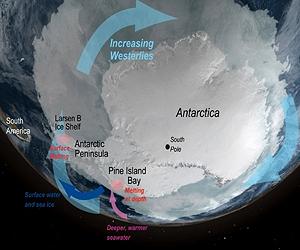
Dec 16, 2010 Scientists have previously shown that West Antarctica is losing ice, but how that ice is lost remained unclear. Now, using data from Earth observing satellites and airborne science missions, scientists are closing in on ice loss culprits above and below the ice.

The findings, presented Dec. 15 at the fall meeting of the American Geophysical Union (AGU) in San Francisco, Calif., are expected to improve predictions of sea level rise.

Time Not Healing Glacial Wounds
A new analysis by Ted Scambos, a glaciologist at the National Snow and Ice Data Center in Boulder Colo., and colleagues found that more than a decade after two major Antarctic ice shelves collapsed, glaciers once buttressed by the shelves continue to lose ice. More >>>

Tuesday, December 14, 2010

Climate-vulnerable island states get boost for moving into renewable energy


13/12/2010
Some of the smallest and most vulnerable island nations in the world will benefit from a new initiative signed off in Cancun last week, aimed at increasing these countries’ access to renewable sources of energy.

A memorandum of understanding was signed between the Alliance of Small Island States (AOSIS), the Government of Denmark, the World Bank, and the United Nations Development Programme (UNDP), recognising the disproportionate harm of climate change for small island developing states and aims to support island countries to scale up their renewable energy efforts and shift to greater energy efficiency.
An 80 million Danish kroner (€11 million) pledge of support from the Government of Denmark has helped kick off the initiative, which is expected to help island states from the Africa, Caribbean, and Pacific Islands regions transition to low-emission, climate-resilient development paths.
World Bank Group President Robert B. Zoellick jointly signed the agreement with Tillman Thomas, Prime Minister of Grenada and head of AOSIS; Lykke Friis, Denmark’s Minister for Climate and Energy; and Helen Clark, UNDP Administrator. Zoellick said the initiative supports a group of nations that have been among the most active and most vocal at climate negotiations for many years.
“Small island developing states have been sounding the alarm about climate change for years now and have earned the title of ‘the conscience of the climate convention’,” Zoellick said. “They are leaders in taking actions on adaptation, and the World Bank Group has increased support to them for this purpose. This new initiative extends this support to clean energy, which will contribute to mitigation and also help reduce the islands states’ very high import bills for fuel.”
Breaking oil dependence
Because of their size and remoteness, most small island developing states are heavily dependent on imported petroleum for their energy needs. Some countries spend an estimated 25 – 50 percent of their GDP on imported oil, which leads to very high domestic electricity costs.
“Reducing fossil fuel consumption is a ‘win-win’ for small island developing states”, said Helen Clark of the UNDP. “It reduces the greenhouse gas emissions responsible for the rise in global temperatures, while at the same time improving energy security and freeing up national spending for investment in climate-resilient development.”
One of the expected benefits from this renewable energy initiative will be the freeing up of “fiscal space” for governments to spend on development and climate-resilient action.
“Climate change has the potential to derail all the good work that countries have undertaken for decades to overcome poverty and boost growth,” Zoellick said. “In countries with the possibilities of renewable energy sources, overall development is undermined if governments are spending so much on imported fossil fuels.”
The World Bank and the UNDP will facilitate the trust fund that will be established from the memorandum of understanding.
For additional information: http://bit.ly/fzaVI0

Friday, December 10, 2010

World Bank: Governance and Climate Change

Governance and Climate Change

According to the World Bank Group’s Governance and Anticorruption Strategy (GAC), governance is “the manner in which public officials and institutions acquire and exercise the authority to shape public policy and provide public goods and services”. Poor governance permits and even promotes corruption resulting in private gain and abuse of public office. Resources that should fuel development and reduce poverty enrich corrupt elites. Institutions matter, and civil society groups and parliaments can promote transparency and accountability, thereby strengthening governance and helping countries achieve the Millennium Development Goals (MDGs).

Good governance is necessary to effectively overcome development challenges and ensure sustainable development. The urgency of addressing these challenges is heightened by the need to combat the impacts of climate change. For developing countries, better management of floods, droughts and storm surges is necessary, while also maintaining gains made in reducing poverty.

Climate change also provides opportunities in using new financial instruments to achieve low carbon, climate-resilient and socially equitable development.  However, for countries to receive international financing to address climate change, adequate governance institutions in developing countries must enable effective use of funds. Other governance-related questions include the following:

• Can funds support public sector works and do adequate institutions exist for implementing projects without corruption concerns?

• Can policy and legislative frameworks be developed for market-based instruments to be used effectively by the private and public sectors for climate-friendly development?

• Can existing institutional frameworks effectively combine weather-related insurance and natural disaster risk management as part of the adaptation agenda?

• Can different line ministries work together to address the climate-development challenges?

• Can public policies provide an umbrella for public-private initiatives, i.e., to: inform consumer choice on energy efficiency appliances and building construction; and ensure land tenure, access and rights of local and indigenous peoples are not eroded through reducing emissions from deforestation and forest degradation (REDD)?

• Can policies be developed to help reduce land-based carbon emissions and land-water degradation, and provide payments to local and indigenous communities to help reduce poverty?

To address some of these questions, the World Bank Institute (WBI) is bringing together its work on governance and climate change in many of its activities and for different stakeholders. For example, youth activists are critical to social accountability efforts, and, as future leaders, they have a role to play in shaping climate-friendly development. Parliamentarians shape national development agendas, and their representative, legislative and oversight responsibilities are essential for taking action on climate change and development. This issue of the e-bulletin addresses what WBI is doing to engage with and enhance the capacity of these stakeholders.

WBI’s Climate Change Practice is also facilitating action on adaptation, particularly in many African countries. The section on knowledge products and activities of the agriculture, water and natural resource management program showcases our efforts in this arena. This e-bulletin also covers other areas WBI is focusing its efforts on, such as Cities and Climate Change. It also addresses the ongoing work of Carbon Finance Assist, which highlights the use of market and, increasingly, non-market instruments to reduce emissions.

I would like to thank Mitchell O’Brien and Miriam Bensky in the WBI Governance Practice for their contribution to this preface. We hope you enjoy these articles and we look forward to interacting with you further.

Habiba Gitay
Sr. Environmental Specialist and Acting Practice Manager
WBI Climate Change Practice

Wednesday, December 8, 2010

Many Strong Voices Holds First Advisory Committee Meeting


30 October 2010: Many Strong Voices (MSV), a collaboration between Arctic and small island developing States (SIDS) that seeks to promote the wellbeing of these areas vulnerable to climate change, held its first Advisory Committee meeting in the Seychelles from 28-30 October. 
The purpose of the Seychelles meeting was to review the MSV five-year plan (2008-2012) and communications strategy, and to identity opportunities and next steps for the MSV initiative.
The MSV Advisory Committee is made up of representatives from Arctic indigenous organizations, nongovernmental organizations, and SIDS representatives. Meeting participants included representatives from the Caribbean Community Climate Change Centre, Organization of American States (OAS), Indigenous Peoples Global Summit on Climate Change, Inuit Circumpolar Council, Cayman Institute and Government of the Cook Islands, as well as the University of Seychelles and the Sea Level Rise Foundation.
Key outcomes of the meeting included: a revised MSV five-year Strategic Plan with a focus on activities in the next two years; agreement on the coordination of an MSV side event on "Voices from the North and South: Food Security and Human Rights in Small Island Developing States and the Arctic" at the 16th Conference of the Parties (COP 16) to the UN Framework Convention on Climate Change (UNFCCC) in Cancun, Mexico; agreement on the initiation of new projects on food security, ecosystem-based adaptation to climate change, and human rights; and the development of a new project on black carbon.
The meeting coincided with an exhibition, titled "Portraits of Resilience," photo and stories on climate change by youth from communities in the Seychelles, Fiji, Tuvalu, Alaska, Greenland, Canada, and Norway. [IISD RS Sources] More >>>

Monday, December 6, 2010

Outside Cancún climate conference, Caribbean Sea testifies to global warming

2010 was one of the deadliest years on record for coral reefs. The Caribbean Sea just outside the Cancún climate conference offers evidence of global warming's negative effect. 

This summer’s extreme heat may seem like a distant memory as winter approaches the United States.

But the summer that broke heat records across the Northern Hemisphere is still being felt below the surface of the Caribbean Sea: 2010 will likely be one of the most deadly years on record for coral reefs.

If diplomats attending the two-week global climate change talks that opened Monday in Cancún, Mexico, want more evidence of the negative and potentially devastating affects of warming temperatures, they need look no further than the blue sea outside their hotels. Researchers say that throughout the Caribbean coral reefs are “bleaching,” a condition that occurs when they are under extreme stress due to warmer-than-normal sea temperatures. More >>>

Saturday, December 4, 2010

Never an Empty Bowl: Sustaining Food Security in Asia


For the first time in history, the number of people suffering from chronic hunger reached one billion globally in 2009, with Asia accounting for approximately two-thirds of the world’s hungry. 
The future looks even more daunting. Population growth, increasing demand from changing diets, dwindling land and water resources for agriculture, higher energy costs, and the huge uncertainties regarding the effects of climate change present scientists and policy makers with additional challenges.
A new Task Force report issued jointly by the Asia Society and the International Rice Research Institute (IRRI) brings together a pragmatic approach to public policy and the best science, with substantial input from key players in the field, to advance a comprehensive plan of action to address food insecurity and poverty in the region. More >>>

Friday, October 15, 2010

Small Island Developing States seek international commitment


Dessima Williams

Alliance of Small Island States’ Chairperson and Grenada’s Ambassador to the United Nations Dessima Williams in an exclusive interview with MediaGlobal’s Nosh Nalavala 
9 October 2010 
MediaGlobal (MG): The most recent talks in Bonn showed that the 194 negotiating countries have failed to even define a common target or method for curbing greenhouse gases. Where do the negotiating countries go from here? Does Alliance of Small Island States (AOSIS) have a strategy for breaking this deadlock?
Dessima Williams (DM): Our strategy is to be prepared for progress and for lack of progress, in the sense that we are working for very ambitious, deliberate and timely outcomes. What we have done is to stress the situation of our islands and of the world. The whole world is suffering from a worsening situation in climate change. Island countries are on the forefront of global climate deterioration. Many economic and physical science studies suggest that we are in trouble. The earth is now hotter than it has ever been, and 93 percent of the warming over the past 50 years has gone into the oceans, which directly affects our coral levels, fish stock, sea-level rise and thus the security of islands. For those reasons, negotiations ought to be moving faster. More >>>

Thursday, October 7, 2010

How Warm Was Summer 2010? : Image of the Day

NASA Satellite Image Showing Global Temperature Anomalies 
More >>>

Sunday, October 3, 2010

China leading the world in clean energy investment


SHANGHAI -- September 30, 2010 -- As weary visitors wait to enter the Shanghai Corporate Pavilion at Expo 2010, a sprinkler system using recycled rainwater and powered through a solar thermal system cools them off with periodic misting. 

Once they enter the exhibit at the world's largest fair, tourists learn about high-speed trains and other energy-efficient inventions that have begun to proliferate in China.

"Shanghai has developed so fast, its natural resources have disappeared," reads one placard at the expo. Several yards away, a film presentation plays in which the narrator asks, "What's the future of Shanghai?"

It is a question that is far from decided. But China's emphasis on developing clean energy sources has rattled some of its economic competitors and could transform the global energy marketplace. More >>>

Tuesday, September 21, 2010

Warming in Deep Southern Ocean Linked to Sea-Level Rise


Warming waters in the deepest parts of the ocean surrounding Antarctica have contributed to sea-level rise over the past two decades, scientists report today (Sept. 20). 

In an attempt to pinpoint all culprits for the rising oceans, scientists analzyed warming trends in the abyssal ocean — below about 3,300 feet (1,000 meters), said study team member and oceanographer Sarah Purkey of the University of Washington in Seattle.

The scientists found that the strongest deep warming occurred in the water around Antarctica, and the warming lessens as it spreads around the globe. The temperature increases are small — about 0.05 degrees Fahrenheit (0.03 degrees Celsius) per decade in the deep Southern Ocean, and less elsewhere. More >>>

Saturday, August 28, 2010

Peak oil: two words to worry about


The crisis would be so severe, we wouldn't be able to run our tractors, heat our homes or drive our cars 

AUGUST 27, 2010 - As if you don't have enough to worry about, add two more words to your list: peak oil.

Forget climate change -peak oil is the biggest problem on the human horizon according to some. Bullcrap, say others.

The idea is actually hard to explain, which may be why many have never heard of it. But if the peak oil theory is true, it will affect us all drastically, so it's worth a shot:

Technically, there is lots of oil left in the world. We're often told the supply could last 40 or 50 years. But peak oil is the exact point at which oil production peaks. The idea is you don't need to run out of oil to get into trouble. You just have to reach the "peak," the point where you've passed maximum output and start to run out. At that point, oil becomes finite and something big happens -the price surges. That jump would be so violent and unavoidable, say some, that the global economy would simply run out of affordable gas and, in a worst-case scenario, would collapse. The crisis would be so severe, we wouldn't be able to run tractors, heat our homes or, naturally, drive our cars. Soon we'd be living like 17th-century pioneers in the shell of our former gas-driven civilization. More >>>

Monday, August 23, 2010

If a Country Sinks Beneath the Sea, Is It Still a Country?


Rising ocean levels brought about by climate change have created a flood of unprecedented legal questions for small island nations and their neighbors. 


Among them: If a country disappears, is it still a country? Does it keep its seat at the United Nations? Who controls its offshore mineral rights? Its shipping lanes? Its fish?

And if entire populations are forced to relocate -- as could be the case with citizens of the Maldives, Tuvalu, Kiribati and other small island states facing extinction -- what citizenship, if any, can those displaced people claim?

Until recently, such questions of sovereignty and human rights have been the domain of a scattered group of lawyers and academics. But now the Republic of the Marshall Islands -- a Micronesian nation of 29 low-lying coral atolls in the North Pacific -- is campaigning to stockpile a body of knowledge it hopes will turn international attention to vulnerable countries' plights.

"At the current negotiating sessions and climate change meetings, nobody is truly addressing the legal and human rights effects of climate change," said Phillip Muller, the Marshall Islands' ambassador to the United Nations. More >>>

Friday, August 20, 2010

Caribbean Storm Damage Costs May Rise 50% With Global Warming


Aug. 19 (Bloomberg) -- Climate change may add 50 percent to the storm damage costs incurred by some Caribbean nations over the next two decades, said Swiss Reinsurance Co., the world’s second-largest re-insurer. 

Wind, storm surges and inland flooding already cost some Caribbean nations up to 6 percent of their economic output each year, the Zurich-based company said today in a statement on its website. Global warming could add costs amounting to another 1 to 3 percent of output by 2030, it said.

Insurers are being hit with more claims as damages from natural catastrophes rise. Costs to clean up after storms and other natural disasters reached a record $180 billion in 2005, of which insurers covered about half, according to Munich Re, the biggest re-insurer. More >>>

Monday, August 9, 2010

How Will Small Businesses Survive Peak Oil?

From Yahoo to Virgin, big business is waking up to the threat of peak oil.  

So much so, that Virgin bross Richard Branson believes we should bemobilizing for peak oil as if for war. But what about the little guy? It's often assumed that because peak oil will make global shipping a challenge, that we'll just transition back to smaller, more local economies. I suspect the truth will be a little more complicated than that.

As much as we TreeHuggers like to espouse the virtues of local business and human scale economies, there can be few businesses out there—big or small—that find themselves immune to the threat of rising energy prices or economic volatility. And as recent events have shown, while corporations may find themselves on shaky ground, there is often a helping hand out there to stop the giants from failing. Will that be the same for the small operators? A small social enterprise in the UK is aiming to ensure that we head the problem off before it becomes a crisis.
 More >>>

Friday, August 6, 2010

Clean Energy and Cultural Survival in Nicaragua

Clean Energy and Cultural Survival in Nicaragua

PARIS, Aug 1, 2010 (Tierramérica) - For the past six years, French and U.S. engineers have been installing solar panels and wind turbines in the southeastern Nicaraguan town of Bluefields, promoting clean energy and development among the region's Rama indigenous peoples.

In 2004, French engineer Lâl Marandin and the Franco-U.S. brothers Guillaume and Mathias Craig founded blueEnergy, a non-governmental organisation with resources and donations from companies and foundations in France and the United States. 

More >>>

Thursday, August 5, 2010

12 Events That Will Change Everything: # 1 Sea Level Rise


This Web-only article is a special rich-media presentation of the feature, "12 Events That Will Change Everything," which appears in the June 2010 issue of Scientific American More >>>

Wednesday, July 14, 2010

Hawaii moves closer to green-energy goals


HONOLULU, July 14 (UPI) -- A 30-megawatt wind farm on the Hawaiian island of Oahu will reduce oil consumption by nearly 140,00 barrels per day, a company said. 


U.S. wind energy company First Wind broke ground on the Kahuku Wind project on Oahu's north shore. The project could provide enough renewable energy to power more than 7,000 homes and reduce oil consumption by as much as 139,500 bpd, the company said in a statement.

Hawaii Gov. Linda Lingle, a Republican, said the project would help the state meet its goal of getting 70 percent of its energy for electricity and ground transportation by 2030. More >>>

Wednesday, July 7, 2010

Public Meeting Dates – Cayman Islands National Conservation Law


Conservation Law Meetings

The Department of Environment is hosting a series of public meetings over the next two weeks so that everyone will have a chance to hear about the proposed (draft) National Conservation Law and have any questions they may have answered. Please, read the Law (and the guide if you have any questions) then come to the meetings and make sure you tell us (using the feedback forms on this website or at the meetings) what you think of the law. It will be up to the public whether this Law goes further than the drafting stage.
Public Meeting Dates – National Conservation Law
DateLocationTime
Thursday July 1stNorth Side Community Centre7 – 9pm
Tuesday July 6thBodden Town Primary School Hall7 – 9pm
Thursday July 8thElmslie Church Hall, GT7 – 9pm
Saturday July 10thTrust House, Little Cayman7 – 9pm
Monday July 12thJohn A. Cumber Hall, West Bay7 – 9pm
Tuesday July 13thEast End Communicty Centre7 – 9pm
Thursday July 15thAston Rutty Centre, Cayman Brac7 – 9pm

Tuesday, June 29, 2010

Maldives - Green growth improves water security – President Nasheed


In his keynote address at the Asia-Pacific Water Ministers’ Meeting in Singapore, President Mohamed Nasheed spoke on the link between the low carbon growth and water security. 


He said, for the Maldives “the links between low carbon growth and water security are particularly pronounced.”

The President said although the most of the country was ocean, the Maldives still had acute fresh and drinking water problems.

He said freshwater lens that provide water for drinking, washing and agriculture has become contaminated by sewage and salt water intrusion forcing a large part of the country to depend on other sources of water including desalinated water.

Many of these problems “arise because of poor governance of water supplies over the past few decades”, added the President.

Speaking on the higher cost and energy inefficiency of desalinated water, the President said, many islands that cannot afford desalinated water rely of unreliable rainwater harvesting. More >>>


Sunday, May 23, 2010

No margin for error

The veteran global investor Mohamed El-Erian, who runs Pimco and has lived through many a financial crisis, recently issued a report describing the new, perilous state of today's global economy.
He described it like this: "The world is on a journey to an unstable destination, through unfamiliar territory, on an uneven road and, critically, having already used its spare tire."

I like that image. America used its spare tire to prevent a collapse of the banking system and to stimulate the economy after the subprime market crash. The European Union used its spare tire on its own economic stimulus and then to prevent a run on European banks triggered by the meltdown in Greece. This all better work, because we're not only living in a world without any more spares but also in a world without distance. Nations are more tightly integrated than ever before. We're driving bumper to bumper with every other major economy today, so misbehavior or mistakes anywhere can cause a global pileup.

And that leads to the real point of this column: In this kind of world, leadership at every level of government and business matters more than ever. We have no margin of error anymore, no time for politics as usual or suboptimal legislation. But what does that mean,
"leadership"? More >>>

53 Megawatt Ice Energy Storage Trial Begins In Glendale, California

About 24 municipal buildings in Southern California are about to help ease the strain on the grid created by the peak need for air conditioning on hot California afternoons. 

Over the next few weeks, a consortium of municipal utilities in California will begin retrofitting government offices and commercial properties with systems that use ice made at night using cheap surplus wind power to replace air-conditioning that they would have required during the afternoon.

The first cheap energy storage cooling units housed at distributed sites on the buildings will be networked, providing utilities with a resource that can be dispatched as needed to help manage demand on the grid. If the pilot project works as expected, it will demonstrate savings, such that if put into general use, would reduce fuel consumption by state utilities by up to 30%, and by individual building owners by up to 90%. More >>>

The Cayman Islands needs to consider off peak electricity rates to enable similar technology to be used here. These islands must move towards energy efficiency and efficiency. Editor